












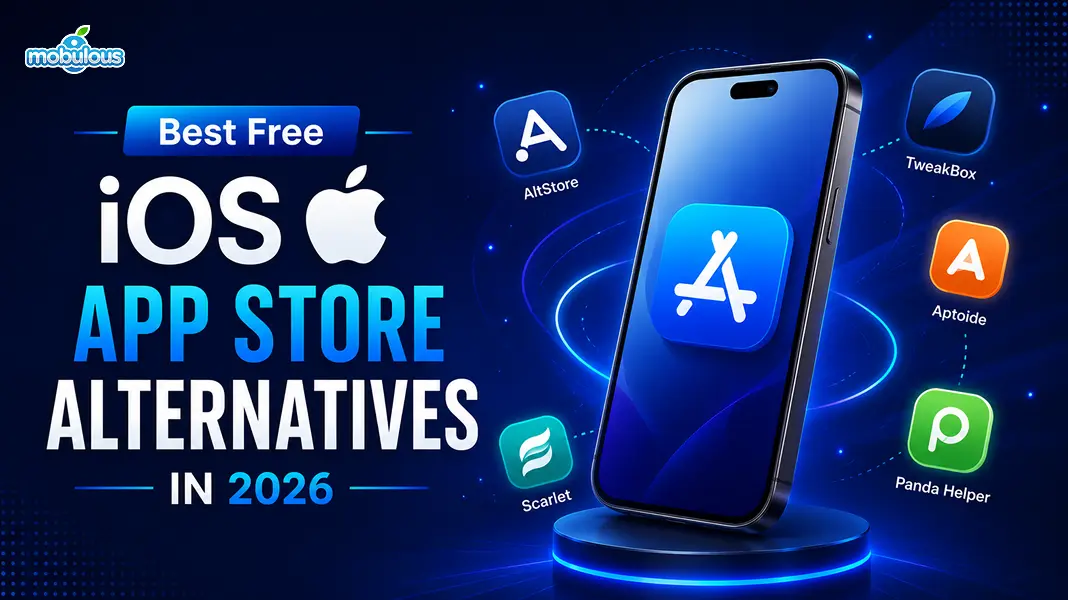
If you’ve ever searched for an app and come up empty on Apple’s storefront, you’re not alone. Thanks to regulatory changes in a handful of countries, iOS App Store alternatives are now a real, working option, not just a jailbreak fantasy, though only for some users and in specific places.
What Are iOS App Store Alternatives?
An iOS App Store alternative is a third-party app marketplace that lets iPhone users discover, download, and update apps outside Apple’s own storefront. Some are fully Apple-authorized marketplaces; others are independent sideloading tools that install apps using your own Apple ID or a signing certificate.
How Alternative App Stores Work on iPhone
Authorized alternative stores install directly from a website through Apple’s official marketplace framework. Apps still pass a lightweight security check called notarization before landing on your device.
10 Best iOS App Store Alternatives in 2026
Before ranking anyone, we checked whether each option is still active, who can actually use it, and whether it’s a genuine marketplace or just a sideloading tool wearing a marketplace’s clothes.
1. AltStore PAL
AltStore PAL is a free, open-source alternative app marketplace built by independent developer Riley Testut. It’s the officially authorized, EU-approved successor to the original AltStore, installable straight from Safari with no computer needed, and its Apple marketplace fees are covered by a grant from Epic Games.
Key features:
- Home to Delta (a multi-console emulator) and UTM SE (a Windows/Linux virtual machine), two apps Apple has never allowed on its own store
- Direct install from Safari, no AltServer or PC required, unlike the original AltStore
- Open, community-driven catalog where users can add third-party “sources”
Best for: Indie developers, emulator fans, and EU users who want a non-commercial, open-source alternative to Apple’s store.
Availability: EU only. Requires an Apple Account region set to an EU country and physical presence there.
| Pros | Cons |
| Free to use, no hidden fees | EU-only, no path for other regions yet |
| Backed by an established, transparent developer | Smaller catalog than the App Store |
| Apple-notarized, officially authorized marketplace | Some flagship apps (like emulators) sit in a legal gray area under local laws |
2. Epic Games Store
Epic’s mobile storefront launched on iPhone in the EU in August 2024, bringing Fortnite back to iOS more than four years after Apple removed it. It’s an Apple-authorized marketplace built primarily around Epic’s own titles, with third-party developer self-publishing gradually rolling out.
Key features:
- Fortnite, Rocket League Sideswipe, and Fall Guys available on iPhone again
- Direct install via Safari using Apple’s official alternative-marketplace framework
- Expanding self-publishing tools for outside developers to list their own games
Best for: Fans of Epic’s own franchises and EU-based gamers who want Fortnite on their iPhone again.
Availability: EU only (iOS 17.6 or later). Epic has talked about expanding further, but as of mid-2026, the iOS store remains EU-exclusive; it is not available in Japan, the US, or India.
| Pros | Cons |
| Fortnite and other big titles are genuinely playable again | Catalog is still narrow, mostly Epic’s own games |
| Backed by a large, financially stable company | EU-only for iOS, unlike its worldwide Android release |
| Apple-notarized and officially authorized | Ongoing friction with Apple over marketplace fees |
3. Aptoide
Aptoide is a long-running Android app-store brand that launched a dedicated iOS gaming store in the EU in June 2024, first through a limited waitlist, then to all EU users without restriction from February 2025 onward. It’s authorized under Apple’s DMA marketplace framework.
Key features:
- App Versions, letting users install older releases of a game, something neither Apple’s store nor most alternatives offer
- Tiered developer commissions that reward apps bringing their own traffic
- Growing catalog weighted toward indie and mid-size games
Best for: EU iPhone gamers who want access to older app builds and smaller indie titles.
Availability: EU only, fully open with no waitlist.
| Pros | Cons |
| Unique App Versions feature for rolling back updates | Primarily games, not a general app store |
| No more waitlist, open to all EU users | EU-only availability |
| Established company with over a decade on Android | Catalog still smaller than mainstream game stores |
4. Onside
Onside is a curated general-purpose marketplace, covering apps and games rather than just games, live in the EU and, as of 2026, in Japan. It’s authorized under both the EU’s DMA and Japan’s Mobile Software Competition Act (MSCA), with a stated focus on secure payments and editorial curation.
Key features:
- Broader category coverage than most alternatives, not limited to gaming
- Card and Apple Pay support at launch, with more payment methods planned
- Editorial collections, ratings, and automatic app updates
Best for: Users who want a full-catalog alternative store rather than a gaming-only marketplace, and developers looking for lower flat commissions.
Availability: EU and Japan. EU requires iOS 17.6+/iPadOS 18+; Japan currently requires an iPhone with iOS 26.2 or later (no iPad support yet). Your Apple Account region and physical location both need to match a supported market.
| Pros | Cons |
| Widest category coverage among the authorized alternatives | Still a young platform with a growing catalog |
| Available in two separate regulatory regions (EU and Japan) | Not available outside the EU or Japan |
| Apple-notarized with stated malware scanning on listings | Payment method rollout is still incomplete |
5. Skich
Skich is a gaming-discovery marketplace for EU iPhone users, best known for a swipe-based, dating-app-style browsing interface. It evolved from an earlier recommendation app into a full Apple-authorized marketplace during 2025.
Key features:
- Swipe left or right to “match” with games based on your taste
- Social features like shareable playlists and friend activity
- A 15% developer commission, undercutting Apple’s standard rate
Best for: Casual and social gamers who prefer discovery-driven browsing over a traditional storefront grid.
Availability: EU only. The iOS game catalog is still relatively small compared to its Android counterpart.
| Pros | Cons |
| Genuinely different discovery experience | Small iOS catalog compared to bigger names on this list |
| Lower developer commission than Apple’s standard rate | EU-only availability |
| Apple-notarized and officially authorized | Games-only, not a general app marketplace |
6. SideStore
SideStore is a free, open-source sideloading tool, not an Apple-authorized marketplace, that installs .ipa app files using your own Apple ID without jailbreaking. Built and hosted in Germany with a stated minimal-data-collection policy, it’s the spiritual successor to the original AltStore’s sideloading model.
Key features:
- On-device app refreshing after an initial computer setup, reducing how often you need a PC
- Minimal data collection, with a public, auditable open-source codebase
- Works outside the EU/Japan since it isn’t tied to Apple’s DMA marketplace framework
Best for: Technically comfortable users anywhere in the world who want to sideload personal or open-source apps without waiting on regional marketplace approval.
Availability: Not region-locked like the marketplaces above, but it is explicitly a sideloading utility rather than a sanctioned alternative app store. Free Apple ID accounts are limited to a small number of apps that must be re-signed roughly every seven days.
| Pros | Cons |
| Works globally, not restricted to the EU or Japan | Not Apple-notarized or officially authorized |
| Open-source and privacy-conscious by design | Free Apple ID accounts face app limits and weekly re-signing |
| No jailbreak required | Small risk of Apple ID flags with heavy use |
7. Scarlet
Scarlet is a third-party IPA installer and signing tool for sideloading .ipa files, including tweaked or modified apps, without jailbreaking. It works more like a certificate-based app installer than a curated marketplace, and it is not an Apple-authorized alternative store.
Key features:
- On-device IPA signing with certificate management
- A repository system for adding custom app sources
- Tweak injection into apps you’ve already installed
Best for: Advanced users comfortable managing signing certificates who specifically want tweaked or modified apps unavailable through official channels.
Availability: Distributed independently online, reachable worldwide in principle, but entirely outside Apple’s notarization or authorization process.
| Pros | Cons |
| No jailbreak required | Not reviewed, notarized, or authorized by Apple |
| Free to use | Relies on certificates that get revoked without warning |
| On-device signing, no computer needed after setup | Frequently distributes tweaked or modified app versions, adding legal and security risk |
8. AppDB
AppDB (appdb.to) is a community-run IPA repository and installer hub that indexes third-party apps for sideloading through tools like AltStore, Sideloadly, or TrollStore. Its listings mix genuine homebrew software with cracked or modified copies of paid apps, which raises real legal and security concerns.
Key features:
- A large, searchable index of .ipa files
- Direct-install links into several different signing tools
- Community ratings on individual app listings
Best for: Honestly, we can’t recommend AppDB as a primary source. It’s included here because it’s widely discussed, but its catalog includes pirated and cracked software, which carries genuine copyright and security risks and should be avoided.
Availability: Web-based and reachable worldwide, but not an Apple-authorized marketplace and not a legally sanctioned distribution channel.
| Pros | Cons |
| Large, searchable catalog of IPA files | Distributes cracked and pirated apps alongside legitimate ones |
| Free to use | No Apple notarization, review, or accountability |
| Works with multiple signing tools | Meaningfully higher malware and legal exposure than any other entry here |
9. TrollStore
TrollStore was a free, open-source tool that exploited a flaw in Apple’s code-signing verification (CoreTrust) to permanently sideload apps without expiry, no jailbreak needed. Apple closed that vulnerability starting with iOS 17.0.1, so TrollStore now only works on devices still running iOS 14 through 17.0.
Key features (on supported iOS versions only):
- Permanent app installs with no seven-day resigning requirement
- No jailbreak needed
- Open-source code that’s been independently reviewed
Best for: Owners of older iPhones deliberately kept on iOS 17.0 or earlier. It is not a practical option for anyone running iOS 26 in 2026.
Availability: Effectively obsolete for current iPhones. The underlying vulnerability has been permanently patched, and no version exists for iOS 18 or iOS 26.
| Pros | Cons |
| Historically the most stable sideloading method; no resigning | Doesn’t work on any iPhone running iOS 17.0.1 or later |
| Open-source and independently reviewed | Effectively dead for 2026-era devices |
| No jailbreak required (on supported versions) | Relies on an exploit Apple has since fixed |
10. ESign
ESign is an on-device IPA signing tool that installs .ipa files using developer certificates, including free “shared” certificates sourced from the community. Like Scarlet, it’s a sideloading utility rather than an Apple-sanctioned marketplace, closely tied to tweaked-app and jailbreak-tweak communities.
Key features:
- On-device signing without needing a computer
- Tweak injection into signed apps
- App customization tools, including icon and bundle ID editing
Best for: Users experienced with certificate management who understand the risks that come with shared or community certificates.
Availability: Distributed independently online, reachable worldwide in principle, but outside Apple’s review and notarization process. Shared certificates are frequently revoked without notice.
| Pros | Cons |
| No jailbreak or computer required after setup | Not Apple-notarized or authorized |
| Free to use | Shared/community certificates get revoked often |
| Supports custom app tweaking | Closely associated with tweaked and modified app distribution |
Best iOS App Store Alternatives Compared
Here’s a quick side-by-side look at where each option stands as of 2026, based only on what could be verified.
| App Store Alternative | Best For | Free? | Region | Apps | Games | Safety |
| AltStore PAL | Open-source/indie apps | Yes | EU only | Limited, curated | Yes (emulators) | Apple-notarized |
| Epic Games Store | Epic’s own game titles | Yes | EU only | No | Yes (focus) | Apple-notarized |
| Aptoide | Older game versions | Yes | EU only | Limited | Yes (focus) | Apple-notarized |
| Onside | General app + game browsing | Yes | EU + Japan | Yes | Yes | Apple-notarized |
| Skich | Social game discovery | Yes | EU only | No | Yes (focus) | Apple-notarized |
| SideStore | Personal sideloading | Yes | Worldwide (unofficial) | Depends on source | Depends on source | Unofficial, use caution |
| Scarlet | Tweaked/modified apps | Yes | Worldwide (unofficial) | Yes | Yes | Unofficial, higher risk |
| AppDB | Not recommended | Yes | Worldwide (unofficial) | Mixed, incl. pirated | Mixed | High risk, avoid |
| TrollStore | Legacy iOS 14-17.0 devices | Yes | Worldwide (unofficial) | Depends on source | Depends on source | Unofficial, obsolete on iOS 26 |
| ESign | Certificate-based sideloading | Yes | Worldwide (unofficial) | Depends on source | Depends on source | Unofficial, higher risk |
How to Install an Alternative App Store on iPhone
There’s no single install process that works everywhere. What you can do depends heavily on where you are, which marketplace you’re using, and which iOS version your iPhone runs.
1. Check Whether Your Region Supports Alternative App Distribution
Apple-authorized marketplaces currently require your Apple Account region and physical location to be set to the EU or Japan. A VPN will not bypass this check.
2. Download the Marketplace From Its Official Website
Authorized marketplace apps can only be installed from the marketplace developer’s own website in Safari, never from a search-result link, ad, or third-party download page.
3. Allow the Marketplace in iPhone Settings
After installing, go to Settings and use “Allow Apps from Developer” to trust the marketplace. iOS shows an install sheet with the developer’s name and app details first.
4. Install and Update Apps
Once trusted, browse the marketplace like a normal app store. Some marketplaces push automatic updates, while independent sideloading tools may require periodic re-signing depending on your Apple ID type.
Are iOS App Store Alternatives Safe?
Safety isn’t a yes-or-no answer here. It depends on which marketplace you’re using, how it reviews apps, and whether you got it from an official source.
1. Apple’s Notarization Process Explained
Notarization is Apple’s baseline security check for apps outside the App Store, combining automated scans and limited human review for malware, accuracy, and basic privacy compliance. Apple itself describes it as more limited than full App Review.
2. How to Identify a Trustworthy Alternative App Store
Stick to marketplaces confirmed in Apple’s own DMA compliance reports, check that the developer behind the store is named and accountable, and read what permissions and data the marketplace itself collects.
3. How to Avoid Malicious or Fake App Stores
Only download from a marketplace’s official website typed directly into Safari, never from a link in an ad, forum post, or unofficial app; be especially wary of anything promising cracked or pirated paid apps for free.
“Alternative” doesn’t automatically mean “unsafe.” The five Apple-authorized marketplaces on this list go through notarization and marketplace authorization. The five sideloading and signing tools do not, which means the responsibility for vetting what you install shifts almost entirely onto you.
Pros and Cons of Using iOS App Store Alternatives
Like most things in tech, alternative app stores are a trade-off, not a straightforward upgrade or downgrade from Apple’s own store.
Advantages of Third-Party App Stores
- Access to apps and games Apple has rejected or never allowed, like console emulators or Fortnite
- Lower commission rates for developers on several authorized marketplaces
- Features Apple’s own store doesn’t offer, like Aptoide’s older-version installs
- More distribution choice for indie and open-source developers
- Alternative discovery experiences, like Skich’s swipe-based browsing
Disadvantages and Potential Risks
- Availability is limited almost entirely to the EU and, more recently, Japan
- Notarization is a lighter check than full App Review, so risk is genuinely higher
- Catalogs are smaller and less complete than Apple’s own store
- Apple can’t process refunds, disputes, or fraud claims for purchases made outside its own commerce system
- Some tools on this list (Scarlet, AppDB, ESign) rely on unofficial certificates or host pirated content, adding legal and security exposure
iOS App Store Alternatives vs. Apple App Store
Neither system is uniformly “better.” Here’s how they actually compare across the factors that matter most.
| Factor | Apple App Store | iOS App Store Alternatives |
| App Selection | Massive, reviewed catalog, some apps rejected or restricted | Smaller, but includes apps Apple won’t allow |
| Security &Privacy | Full App Review plus ongoing enforcement | Notarization only; varies by marketplace |
| Pricing &Fees | Up to 30% commission (often lower for small developers) | Often lower commissions on authorized marketplaces |
| App Updates | Centralized, automatic, tightly integrated | Marketplace-dependent; some require manual re-signing |
| Developer Support | Apple handles refunds, disputes, and support | Marketplace or developer handles these directly |
For most people, the App Store remains the simplest, most supported option. Alternative stores make sense for specific needs: a particular game, an emulator, or a lower fee structure, and mainly for readers in the EU or Japan.
Which iOS App Store Alternative Is Best for You?
The right pick depends heavily on what you want and, just as importantly, where you’re located.
1. Best Alternative for Games
Epic Games Store is the strongest pick for gamers, mainly because it brought Fortnite back to iPhone along with Rocket League Sideswipe and Fall Guys, backed by a company with the resources to keep expanding its catalog.
2. Best for Open-Source Apps
AltStore PAL leads here, hosting genuinely open-source projects like the Delta emulator and UTM SE, with a transparent, non-commercial model funded by an Epic Games grant rather than user fees.
3. Best for Businesses
Among the ten covered, Onside’s broad, non-gaming category coverage makes it the closest fit for general business-relevant apps; true enterprise app distribution still belongs on Apple’s own Business Manager channel.
4. Best Overall iOS App Store Alternative
AltStore PAL earns the overall recommendation for its combination of official Apple authorization, zero cost, established developer reputation, and a genuinely different catalog that doesn’t just chase Apple’s own App Store.
Final Verdict: Which iOS App Store Alternative Should You Choose?
For most readers, AltStore PAL and Epic Games Store stand out as the strongest, most accountable options, if you’re in the EU or Japan. Everyone else is largely limited to independent sideloading tools, which carry real trade-offs. Wherever you land, download only from a marketplace’s official website, and treat regional restrictions as a genuine legal boundary, not a hurdle to route around.
Frequently Asked Questions – iOS App Store Alternatives
Q1. Can you install an alternative App Store on iPhone?
Ans. Yes, but only under specific conditions. Apple-authorized marketplaces like AltStore PAL, Epic Games Store, Aptoide, Onside, and Skich currently require your Apple Account region and physical location to be in the EU or Japan.
Q2. What is the best alternative to the iOS App Store?
Ans. AltStore PAL is generally considered the strongest overall option in 2026, thanks to its official Apple authorization, free and open-source model, and unique catalog of apps like emulators that Apple’s own store won’t allow.
Q3. Are alternative iOS app stores safe?
Ans. It depends entirely on which one you use. Apple-authorized marketplaces go through notarization, a lighter security check than full App Review, while independent sideloading tools carry a higher risk since they skip that process entirely.
Q4. Can I install alternative app stores outside the EU?
Ans. For Apple’s officially authorized marketplaces, no; eligibility is tied to your Apple Account region and physical location, and VPNs don’t bypass this. Independent sideloading tools like SideStore work outside the EU but aren’t official marketplaces.
Q5. Can I use alternative app stores in India?
Ans. Not currently. India’s Competition Commission has an active antitrust case against Apple, focused mainly on in-app payment systems, but as of 2026, there is no Apple-authorized alternative app marketplace operating in India.
Q6. Does Apple allow third-party app stores?
Ans. Yes, but only in regions with laws requiring it. Apple currently permits authorized alternative marketplaces in the EU under the Digital Markets Act and in Japan under the Mobile Software Competition Act, nowhere else as of 2026.
Q7. Do alternative app stores require a jailbreak?
Ans. No. All ten options covered here work without jailbreaking. Apple-authorized marketplaces use official sideloading APIs, while independent tools like SideStore, Scarlet, and ESign use your Apple ID or developer certificates instead of a jailbreak exploit.