

















Ask 5 agencies for a super app quote, and you may get 5 answers, anywhere from $20,000 to over $500,000. That gap is not always dishonesty. It usually reflects different assumptions about scope, architecture, and quality, which is why super app development cost needs explaining rather than guessing.
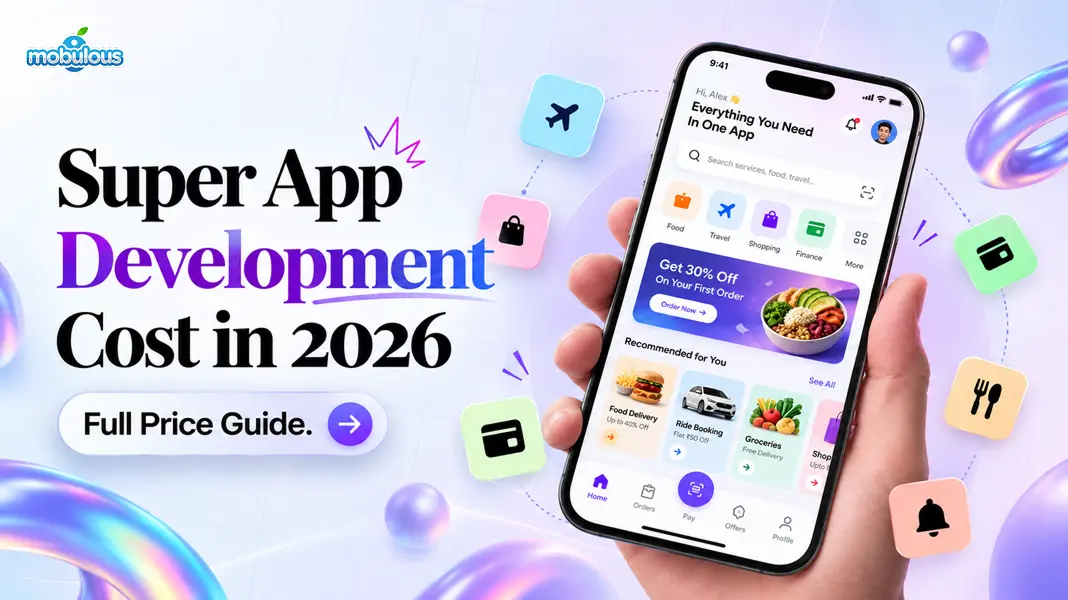
A super app is a single app that hosts several services, such as ride booking, food delivery, payments, and shopping, under one login and one wallet. WeChat, Grab and Gojek are well-known examples. Behind the simple home screen sits a full platform, not just a bigger app.
This blog breaks down what you pay for, what moves a quote up or down, what it costs to run after launch, and when a super app is the wrong call. The figures are indicative ranges, not fixed prices, and they will shift with your market and requirements.
How Much Does It Cost to Build a Super App?
The cost to build a super app typically falls into 3 bands: a lean MVP, a mid-complexity platform, and an enterprise-grade ecosystem. The ranges below are indicative estimates for 2026, based on typical project scopes. Your own quote will depend on how many services you launch with.
| Type of Super App | Development Cost | Typical Complexity | Suitable Use Case |
| MVP / initial version | $20,000 to $60,000 | 2 to 3 core services, one shared login and wallet, basic admin panel | Startups testing demand in 1 city or niche |
| Mid-complexity super app | $60,000 to $200,000 | 4 to 6 services, iOS and Android, richer payments, vendor tools, analytics | Funded startups or established businesses adding adjacent services |
| Enterprise-grade super app | $200,000 to over $500,000+ | Many services, partner or mini-app platform, high-scale architecture, compliance, multiple regions | Large enterprises, banks, telecoms and retail groups |
Where your team sits also matters. Rates in North America and Western Europe are usually higher than in India, sometimes by a wide margin. For Indian teams, indicative estimates tend to sit in the lower part of each band above.
What You Are Paying for When You Pay for a Super App
A super app budget covers far more than screens. You are paying for a connected ecosystem of design, code, infrastructure, and integrations that has to work together reliably.
1. Product Strategy
Before anyone writes code, someone has to decide which services launch first, how they connect, and what success looks like. This covers research, user journeys, feature prioritisation, and a roadmap. It is often underbudgeted, yet it prevents expensive rework later when scope changes midway.
2. UI/UX Design
Design in a super app is harder than in a single-purpose app. Users must move between services without feeling lost, so navigation, visual consistency, and onboarding need careful thought. The budget covers wireframes, prototypes, a design system, and usability testing for every module, not just the home screen.
3. Mobile App Development
This is the app users touch: the iOS and Android builds, screens, offline behaviour, push notification handling, and device features such as camera and GPS. Cross-platform frameworks like Flutter or React Native can reduce effort, while native builds suit apps that need maximum performance.
4. Backend Development
The backend is the engine room: servers, databases, and business logic that handle accounts, orders, bookings, wallets, and admin tools. Users never see it, but it usually takes a large share of the budget because every service in the app depends on it working correctly.
5. APIs
An API (application programming interface) lets 2 systems exchange data. A super app needs internal APIs so modules can talk to each other, plus public or partner APIs so vendors and outside services can plug in. Well-documented APIs make future expansion faster and cheaper.
6. Payment Integrations
Payments are rarely just a checkout button. You may need cards, UPI, or bank transfers, wallets, refunds, split payments between vendors, and reconciliation reports. Each gateway integration, plus the security and testing around it, adds real effort, especially when you operate across multiple countries.
7. Cloud Infrastructure
Your app needs somewhere to live. Setting up cloud environments on AWS, Google Cloud, or Azure includes servers, storage, load balancing, backups, staging and production separation, and deployment pipelines. A sound setup now helps the app handle growth without constant firefighting.
Factors That Influence Super App Development Costs
Most of the swing in a quote comes from a handful of variables. Understanding them helps you see where your own project sits and where you can make sensible trade-offs.
1. Number of Platforms
Launching on Android only costs less than launching on Android, iOS, and web. Each platform needs its own testing across devices and screen sizes. Cross-platform frameworks share much of the code, but separate admin dashboards and vendor panels still add to the platform count.
2. Number of Services
Each service is close to a product of its own. Food delivery needs restaurant onboarding, menus, and rider tracking. Adding ride-hailing brings driver verification, fare calculation, and live dispatch. 2 services and 6 services sit in very different budget brackets, even on the same shared platform.
3. Feature Complexity
2 apps can both offer “delivery” with very different effort. A simple order form is quick to build. Live rider tracking, dynamic pricing, in-app chat, and automated dispatch each add significant logic. Features that involve real-time data or money movement usually cost the most.
4. UI/UX Complexity
A clean template-based interface costs less than a fully custom design with animations, multiple user roles, and accessibility support. A super app often has separate experiences for customers, vendors, drivers, and admins. Each role needs its own flows, which multiplies design and testing effort.
5. Backend Architecture
A monolith is a single codebase that runs everything. Microservices split the system into independent pieces that can scale separately. Monoliths are cheaper to start with, while microservices cost more upfront but suit larger ecosystems. Choosing wrongly can mean an expensive rebuild when user numbers grow.
6. API & Third-Party Integrations
Maps, SMS, payment gateways, identity checks, accounting tools, and delivery partners all have their own documentation, quirks, and costs. Integrating one is manageable. Integrating a dozen, each with failure handling and testing, takes real time. Legacy enterprise systems with poor documentation are usually the hardest.
7. Security, Scalability & Compliance Requirements
An app holding wallets and personal data must meet higher standards. Encryption, secure authentication, audit logs, and penetration testing add cost. Regulations such as GDPR, PCI DSS, or local financial rules may apply, and designing for heavy traffic from day 1 needs additional engineering.
What Pushes a Quote From the Floor to the Ceiling
2 agencies can read the same brief and quote wildly different numbers. Usually neither is lying. They are pricing different versions of the product.
1. Scope
One agency may price a basic order flow; another a full vendor management system with reporting. If the brief says “food delivery module” without detail, each team fills the gaps differently. Ask every company to list what is included and, just as importantly, what is excluded.
2. Technology Choices
The technology stack, meaning the languages and tools used, affects both price and flexibility. Mainstream, well-supported technologies make hiring developers easier later. A niche framework may look cheaper or more impressive today, but can become costly to maintain and hard to hand over.
3. Architecture Quality
Good architecture is invisible until it fails. A well-planned system lets you add a new service without disturbing existing ones. A rushed one forces developers to patch around old decisions. Lower quotes sometimes skip this planning, and the bill arrives later as rework.
4. UI/UX Quality
A design can look fine in screenshots and still frustrate real users. Research-led design, tested prototypes, and a consistent design system take time. Cheaper quotes often rely on stock templates, which can work for an MVP but may limit your brand and conversion.
5. QA Depth
Quality assurance (QA) is the testing that catches bugs before your customers do. Thorough QA includes automated tests, device testing, load testing, and regression checks. When a quote is unusually low, reduced testing is one of the first places corners get cut.
6. Security
Security work is easy to leave out of a quote and painful to add later. Proper encryption, role-based access, secure API design, and independent security testing all take effort. For an app that handles payments and personal data, this is not a place to economise.
7. Scalability
An app that works for 1,000 users may struggle with 100,000. Planning for scale means load balancing, caching, database optimisation and monitoring. You may not need all of it on day 1, but your architecture should leave room to grow without a rewrite.
Low quote versus total cost of ownership:
This is where a low initial quote can mislead. Suppose Quote A is $40,000 and Quote B is $65,000. If A needs $30,000 of rework in 1 year and costs more to maintain, it ends up being the more expensive option. Total cost of ownership means the build cost plus fixes, upgrades, hosting, and maintenance over several years.
Why a Super App Costs More Than the Sum of Its Parts
Building 4 separate apps is not the same as building 1 super app with 4 services. When services share one login, wallet, and database, they must also agree on rules, data, and behaviour. That coordination work does not appear in any single feature’s price.
Here is what that shared layer involves:
- Shared authentication & user profiles
- Unified payments
- Common databases & cross-service data flows
- Notifications & permissions
- Analytics & centralised administration
- Interoperability, scalability & security
What You Pay Every Month Once It Is Live
Launch is not the finish line. Development is a one-off capital cost, while hosting, services, and support are recurring costs that continue for as long as the app runs.
1. Cloud Hosting
Hosting costs depend on traffic and architecture. An early-stage app might spend a few hundred dollars a month, while a busy platform can spend many thousands. Costs rise with users, data volume, and the number of environments you run, so ask for a realistic projection.
2. Database Infrastructure
Managed databases, backups, and standby copies carry their own monthly bills. As transaction history, chat logs, and user data grow, storage and performance needs grow too. Databases that serve several services at once often need larger instances and more careful tuning than a single app would.
3. Third-Party APIs
Many services charge per use. Identity verification, SMS gateways, email delivery, chat tools, and analytics platforms typically bill by volume or subscription. Costs look small at pilot scale and grow with adoption, so model them against your expected user numbers before launch.
4. Payment Processing
Payment gateways usually take a percentage of each transaction plus a small fixed fee, and rates vary by country, payment method, and negotiated terms. This is a cost of doing business rather than a development cost, so build it into your pricing and margins early.
5. OTP
One-time passwords (OTPs) verify phone numbers at sign-up and login. Each SMS or WhatsApp message costs a small amount, but millions of messages add up. Many teams reduce spend by combining channels, adding rate limits, and using app-based authentication where suitable.
6. Location APIs
Ride, delivery, and local services rely on maps, geocoding, routing, and live tracking. Map providers usually charge by request volume, and heavy usage can become one of the larger recurring bills. Caching results and choosing the right provider for your region can help control it.
7. Monitoring
Monitoring tools track crashes, slow responses, and server health so problems are caught before users complain. Error tracking, uptime alerts, and log management carry subscription fees, and someone has to watch them. Good monitoring costs little compared with a long unnoticed outage.
How Much Does a Super App Development Company Cost in 2026?
When you hire a development company, you are not paying for coding hours alone. You are paying for expertise, a team of specialists, project management, technology decisions, and accountability for delivery. How that cost is structured depends on the pricing model, and each model suits a different situation.
1. Fixed-Price Development
You agree on a set price for a defined scope. It gives budget certainty and works when requirements are clear and unlikely to change. The limitation is flexibility: changes usually trigger change requests, and vague scope tends to produce padded quotes or disputes.
2. Time & Materials
You pay for the hours actually worked. It suits evolving products where you will learn and adjust as you go, and you only pay for what is built. The trade-off is less certainty, so you need good reporting and active involvement.
3. Dedicated Development Team
A team works exclusively on your product for a monthly fee. It suits long-term, growing platforms where you want continuity and deep product knowledge. It is less efficient for small, short projects, and you need enough work to keep the team busy.
4. Milestone-Based Development
Payment is tied to delivery stages, such as design sign-off, backend completion, and beta release. It offers visibility and shared accountability, and it pairs well with phased super app builds. The limitation is that milestones need careful definition to avoid disagreements.
5. Why Discovery Makes Estimates More Reliable
Whatever model you choose, a proper discovery or scoping phase makes the final estimate far more reliable. It typically produces a feature list, user flows, an architecture outline, a risk assessment, and a phased roadmap. You pay a little earlier, but you stop guessing at the highest costs.
When Paying for a Super App Is the Wrong Decision
A super app is a big commitment, and it is not right for every business. If your idea only works when everything is built at once, or you cannot explain why users need several services in one place, pause before spending serious money.
A super app is likely the wrong move when:
- You have 1 core service.
- There is not enough demand for multiple services.
- The services do not support each other.
- You cannot run multiple services operationally.
- The business model is unproven.
- The complexity outweighs the customer benefit.
Conclusion
There is no universal super app development cost. Projects range from about $20,000 to over $500,000, depending on scope, architecture, features, integrations, team, scalability, and long-term needs. The right budget is the one that matches your business model and growth plan, not the lowest number you can find.
If you have a super app idea, whether it is a rough concept or a detailed plan, you are welcome to talk through your requirements with the Mobulous team and get a more specific estimate.
FAQs
Q1. How much does it cost to build a super app in 2026?
Ans. In 2026, super app development cost typically ranges from $20,000 to over $500,000. A lean MVP sits at the lower end, a mid-complexity platform in the middle, and an enterprise-grade ecosystem at the top. Your final figure depends on services, platforms, integrations, security needs, and the team you choose.
Q2. What is the minimum budget required for a super app MVP?
Ans. A realistic super app MVP budget starts around $20,000 and often exceeds $40,000 once you include design, a shared wallet, an admin panel, and testing. Below that, you are usually getting a prototype or a single-service app rather than a platform you can launch.
Q3. Why is a super app more expensive than a normal mobile app?
Ans. A super app needs shared systems that a normal app does not: unified accounts, wallets, permissions, admin controls, and cross-service data flows. Each service brings its own logic, vendors, and edge cases, and the security, scalability, and testing demands grow with every module added to the ecosystem.
Q4. How long does it take to develop a super app?
Ans. Most super apps take 4 to 12 months to develop. An MVP with 2 or 3 services may be ready in 4 to 6 months, while enterprise platforms with many integrations and compliance work sit at the top end or run longer. Phased delivery can shorten the first launch.
Q5. Can you build a super app in phases?
Ans. Yes, and for most businesses it is the sensible route. Launch with 1 or 2 core services, a shared login and wallet, then add modules as demand is proven. This spreads spending, reduces risk, and lets real user behaviour guide what you build next.
Q6. How to reduce super app development costs?
Ans. To lower the cost of building a super app, reduce scope before quality. Launch fewer services, use cross-platform development, reuse proven components, and defer features you cannot yet justify. Invest in discovery to avoid rework. Cutting security or testing to save money usually costs more later.
Q7. What does a super app cost to run after launch?
Ans. Running costs include cloud hosting, databases, SMS and OTP messages, map and location APIs, payment gateway fees, and monitoring. These start small, perhaps a few hundred dollars monthly, and grow with user numbers. Maintenance and support are separate and should be budgeted alongside them.
Q8. How much does super app maintenance cost?
Ans. Annual super app maintenance typically falls between $25,000 and $300,000, depending on scale and the level of support. These are indicative figures. That covers bug fixes, OS updates, security patches, performance tuning, and small enhancements. New modules and major features are usually quoted separately.
Q9. How much does a super app development company cost in India?
Ans. Indian teams are usually more affordable than US or UK ones, and the figures here are indicative estimates only. An MVP may start around $20,000 to $40,000, mid-complexity builds often run higher, and enterprise projects can exceed $200,000. Actual quotes vary because scope, team seniority, and testing depth differ.
Q10. How to choose a super app development company?
Ans. Look for proven experience with multi-service platforms, not just single apps. Ask for relevant work samples, a clear scoping process, transparent pricing, security practices, post-launch support, and code ownership terms. Speak to their team, check references, and be wary of quotes that arrive without questions.