
















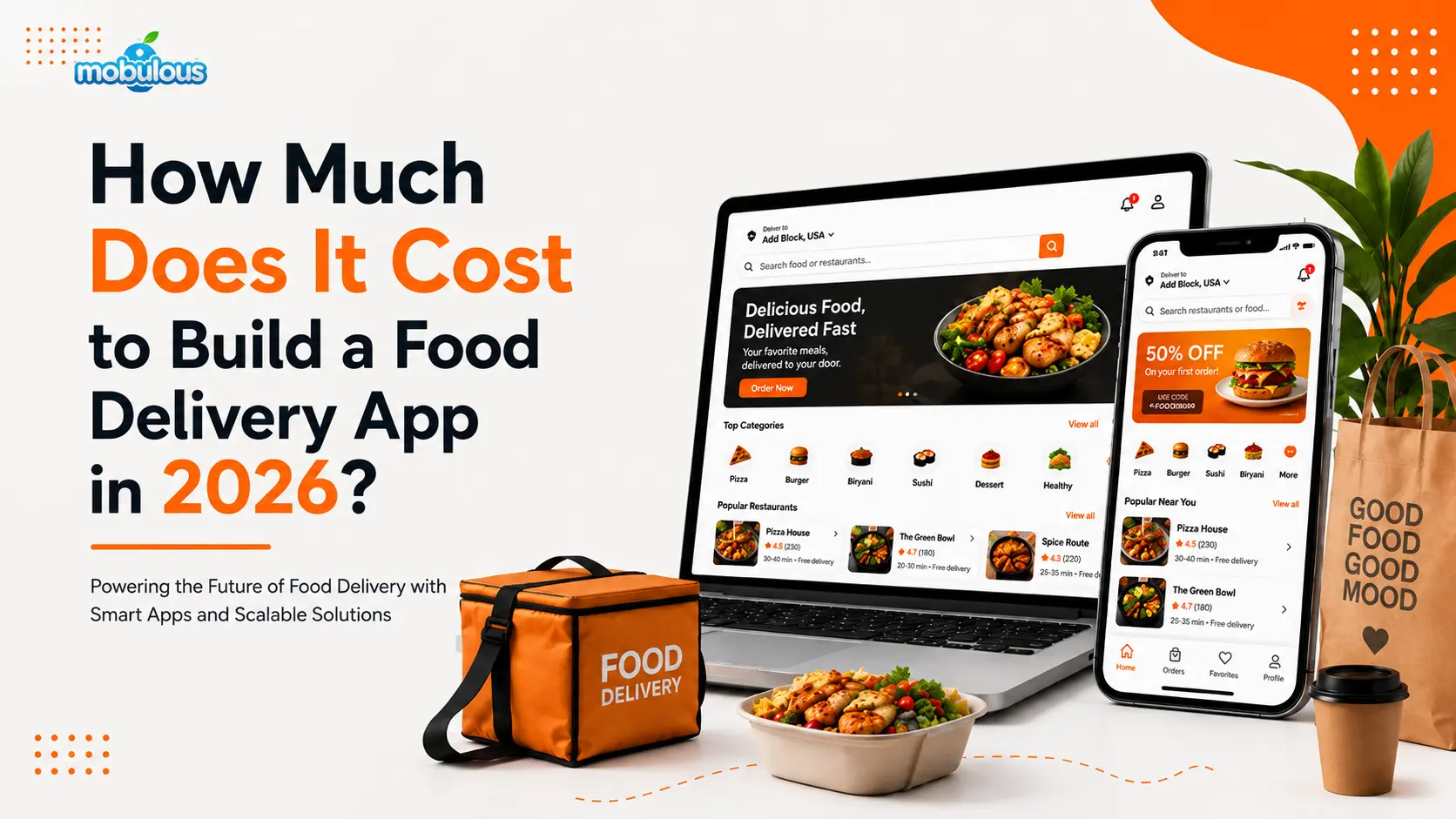
Building a food delivery app in 2026 is no longer reserved for large corporations with massive budgets. The cost to build a food delivery app can be as little as $20,000, while a feature-rich platform with multiple user panels, live tracking, and advanced integrations can easily reach $100,000 or more, depending on scope.
The gap between those numbers comes down to complexity. A simple MVP focuses on essential ordering and payment functions. A larger platform demands customer, driver, restaurant, and admin interfaces working together in real time. Every added feature, integration, and customization increases development effort, which directly impacts the final investment required.
Food Delivery App Development Cost 2026: Breakdown
Food delivery app development cost 2026 varies significantly depending on features, platform scope, and business goals.
|
App Type |
What It Includes |
Average Cost |
|
Basic MVP |
Customer app, restaurant listings, user registration, ordering system, payment integration |
$20,000 – $35,000 |
|
Standard App |
Customer app, driver app, restaurant panel, admin dashboard, real-time order tracking, notifications |
$35,000 – $70,000 |
|
Advanced App |
Multiple user panels, analytics, loyalty programs, advanced search, third-party integrations |
$70,000 – $100,000 |
|
Uber Eats-like App |
AI recommendations, live tracking, route optimization, in-app chat, scalable backend infrastructure |
$100,000 – $250,000 |
|
Enterprise App |
Multi-city operations, custom integrations, advanced reporting, automation, high-volume order management |
$250,000+ |
Want to build something similar? Talk to our food delivery app development team!
Key Factors Affecting Cost to Build a Food Delivery App
The cost to build a food delivery app shifts depending on features, platforms, design depth, integrations, and team geography.
1. App Complexity & Feature Requirements
Simple ordering systems stay lean and predictable, then reality steps in. Real-time tracking, surge pricing, smart recommendations, and multi-restaurant coordination change everything. Each feature adds logic, edge cases, and testing cycles. The cost increases sharply as complexity moves beyond basic ordering into live operations.
2. Number of User Panels
Every panel is a separate world with its own rules. Customers browse and pay, drivers navigate routes, restaurants manage menus and orders, and admins control the entire system. These layers must communicate without friction. More panels mean more screens, more logic, and more coordination, pushing cost higher with each addition.
3. Platform Choice
Platform choice sets the financial direction early. Native development gives smoother performance and tighter control, but doubles effort across iOS and Android. Cross-platform reduces duplication but trades off some flexibility. That trade sits at the center of the Uber Eats app development cost discussion and shapes long-term maintenance as well.
4. UI/UX Design Complexity
Design is not surface polish, but it is structure and behavior. Simple interfaces cost less, but modern users expect speed, clarity, and subtle motion that guides every tap. Crafting that experience takes time and precision. More refinement means more design hours, and that directly increases the cost.
5. Third-Party Integrations & APIs
No food delivery app stands alone. Payment systems, GPS tracking, messaging tools, and analytics platforms all plug into the core. Each integration adds setup time, security checks, and ongoing maintenance. As the stack grows, so does complexity, and cost rises in parallel with every external dependency.
6. Development Team Location & Hourly Rates
Where the team sits changes everything. Developers in North America or Western Europe charge premium rates. Teams in South Asia or Eastern Europe offer lower costs while maintaining solid execution. Same app, different geography, completely different budget. Location quietly but strongly shapes the final Uber Eats app development cost.
Features That Affect Food Delivery App Development Cost 2026
Feature decisions define complexity, engineering effort, and total time required to build a working food delivery platform.
1. Must-Have Features in 2026 Food Delivery Apps
Search, menu browsing, secure payments, order placement, and live tracking form the baseline. Users expect speed, clarity, and instant updates everywhere.
2. Advanced Features
Personalized suggestions, demand prediction, and live GPS tracking increase backend pressure. These features rely on constant data flow and tightly synced systems.
3. Admin Panel, Driver App, & Restaurant Panel Costs
Three connected systems run everything. Admin oversees operations, drivers manage deliveries, and restaurants handle orders. Each requires separate logic, updates, and ongoing maintenance effort.
4. Optional Features That Increase Budget
Loyalty programs, chat systems, scheduled deliveries, multi-language support, and subscription models expand scope. Each one adds development time and increases the overall cost noticeably.
Hidden Costs in Food Delivery App Development
Real expenses surface after launch, often growing steadily with usage, scale, and system maturity over time.
1. App Maintenance & Updates
Nothing stays stable after release, as bugs appear in real usage, not in testing rooms. Operating system updates break features quietly. Devices change, behaviors shift, and fixes become routine. Maintenance turns into a constant loop of debugging, patching, and updating that steadily increases long-term spending.
2. Server & Hosting Costs
Every tap triggers server activity like orders, tracking, notifications, all of it. Growth changes the math quickly. More users demand more storage, faster processing, and stronger uptime guarantees. Costs start predictable, then rise with traffic. Scaling infrastructure becomes unavoidable as demand pushes systems harder each month.
3. API & Third-Party Subscription Fees
Maps, payments, SMS, and analytics services all sit outside your system but power it fully. Each one charges per usage or subscription level. Small at first. Noticeable later. As traffic increases, these recurring fees grow quietly and become a fixed monthly burden that rarely shrinks.
4. Marketing & User Acquisition Costs
An app without users is silent, so getting attention costs money every time. Ads, coupons, referral bonuses, and partnerships drain budgets quickly. Competition makes it worse, plus each new user carries a price tag, and keeping them engaged demands even more spending over time.
5. Security & Compliance Costs
Data protection is continuous work. Payment safety, encryption, audits, and compliance standards like PCI DSS and GDPR require constant attention. Tools and specialists are not optional. Costs stay in the background but remain critical, because one failure breaks trust instantly and creates far greater losses.
How to Reduce Food Delivery App Development Cost 2026
Smarter planning, fewer features, and better tech choices reduce cost without slowing down core product delivery.
1. Start with an MVP
Begin with a minimal version like core ordering, payments, and tracking only. Launch fast, learn from real users, then expand features based on actual demand instead of assumptions that inflate initial build cost unnecessarily.
2. Prioritize Must-Have Features
Focus on essentials first. Search, ordering, payments, and delivery tracking. Skip extras early. Every additional feature increases complexity, testing time, and backend load, which directly pushes development cost higher without improving early user adoption significantly.
3. Use Cross-Platform Development
One codebase for iOS and Android reduces duplication. It speeds up development and lowers maintenance effort. Tradeoffs exist in customization depth, but for early-stage apps, cost savings often outweigh platform-specific refinements and separate builds.
4. Use Ready-Made Integrations
Avoid building everything from scratch. Payment gateways, maps, and notifications already exist as ready solutions. Integrating them cuts development time sharply and reduces engineering effort while maintaining reliable performance across essential app functions.
5. Choose the Right Development Partner
Experience matters more than size. A skilled team avoids rework, reduces errors, and builds cleaner systems from the start. Poor choices lead to delays and repeated fixes, which quietly inflate overall development cost far beyond initial estimates.
Conclusion: What Budget Should You Plan for in 2026?
The cost to build a food delivery app in 2026 typically comes between $20,000 to $100,000. Simple ordering systems stay near the lower range, while multi-panel platforms with tracking, payments, and integrations move higher. Features, scale, and stability demands decide the final food delivery app development cost more than anything else.
Start small and precise. Define the core problem, then build only essential features first. Launch a working version quickly, even if it feels basic. Observe real users closely as their behavior reveals what matters. Then expand gradually, adding features only when demand proves they are necessary.
FAQs – Food Delivery App Development Cost 2026
Q1. What is the average food delivery app development cost 2026?
Ans. The average food delivery app development cost 2026 ranges from $20,000 to $100,000, depending on features and system complexity. Simple apps sit lower, while scalable platforms cost more. Mobulous, with 500+ clients, helps define clear scopes so businesses avoid unnecessary features that inflate budgets without improving real usage.
Q2. What factors affect the cost to build a food delivery app?
Ans. Cost depends on features, number of panels, integrations, platform choice, and UI depth. Even small additions shift timelines and effort significantly. Mobulous, with a 4.7/5 Clutch rating, follows structured delivery practices that reduce rework and keep development aligned with planned budgets across different app sizes and complexities.
Q3. How much does it cost to build an MVP food delivery app in 2026?
Ans. An MVP usually costs between $20,000 and $35,000. It includes essentials like ordering, payments, and basic tracking. Mobulous, with 700+ apps delivered, often recommends MVP-first builds. This approach reduces risk, speeds up launch, and validates demand before investing in advanced features or large-scale infrastructure.
Q4. How much does it cost to build an app like Uber Eats in 2026?
Ans. An Uber Eats app development cost typically ranges from $100,000 to $250,000 or more. It requires multiple user panels, live tracking, analytics, and strong backend systems. Mobulous, operating across 7 countries, builds such platforms with scalability in mind, where performance and feature depth directly drive final development cost.
Q5. How can startups reduce food delivery app development costs?
Ans. Start lean and focus on core features first, and avoid unnecessary complexity. Use ready integrations and cross-platform development when possible. Mobulous, with ISO 9001:2015 certification, often advises startups to launch simple versions first, then expand gradually based on real user behavior instead of assumptions or early feature overload.