















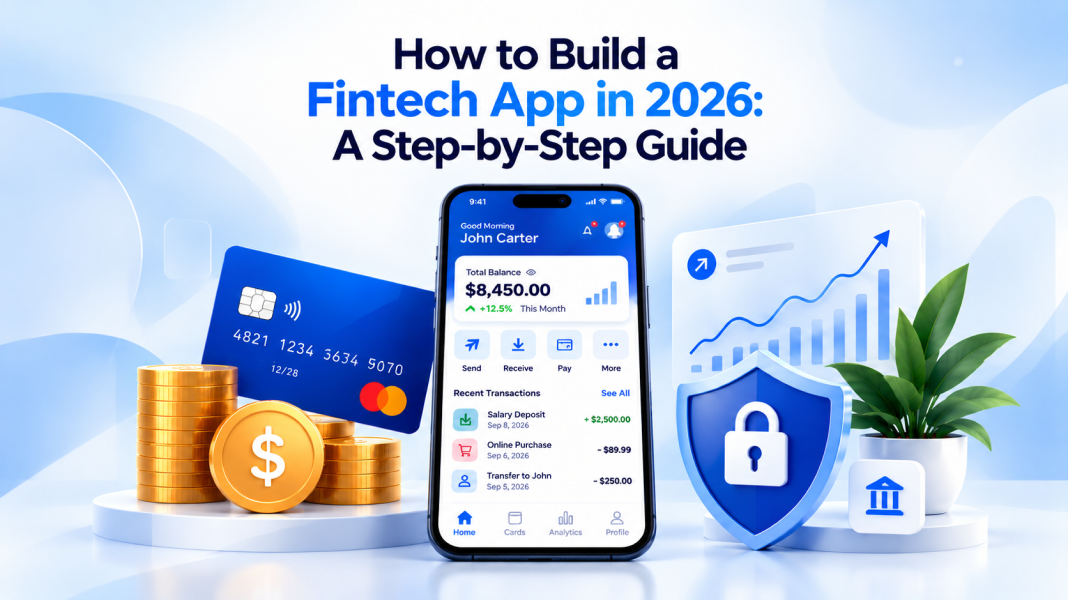
Short answer: To build a fintech app, validate the problem, choose your business model and regulatory route, define a focused MVP, select a secure architecture, integrate licensed partners through APIs, test security and failure paths, launch in stages, and maintain the product continuously. This Fintech App Development guide details illustrative budgets running from about $20,000 to $300,000 or more, and timelines from 2 to 10 months.
Customers expect to move money from their phones in seconds, but a weak plan, loose security, poor technology choices, or missed compliance can sink a product before launch. This guide explains how to build a fintech app in 2026, starting with the fundamentals.
Understanding Fintech App Development is essential for success in today’s digital financial landscape.
What Is a Fintech App & How Does It Work in 2026?
A fintech app is software that delivers financial services, such as payments, lending, or investing, through a digital interface. It relies on APIs, databases, security controls, and regulated partners such as banks and payment processors to move money, verify identities, and keep records.
Example: How a Digital Payment Works Step by Step
Imagine a user paying a merchant $25 from a wallet linked to a bank account.
- Request: The user scans a merchant QR code, confirms $25, and taps Pay. The app asks for a fingerprint, face scan, or PIN.
- Authentication & authorization: The backend confirms the session is valid, the device is recognized, and this user may make this payment.
- Validation: Services check the balance, spending limits, and fraud risk. An idempotency key (a unique ID that stops the same payment from being processed twice) guards against double taps.
- Partner call: The backend sends a payment instruction through an API to the gateway, bank, or payment scheme that actually moves the funds.
- Response: The partner replies approved, declined, or pending. A timeout is not a decline, so the system checks the payment’s real status before showing a final result.
- Recording: The ledger posts balanced entries, and an audit log records the event.
- Notification & settlement: Both parties receive confirmations. Days later, settlement and reconciliation match your records against the partner’s statements.
What Are the Different Types of Fintech Apps You Can Build with Fintech App Development?
Financial app development spans several categories, each serving different users, workflows, and regulatory obligations. Choosing the right one shapes your features, partners, licensing route, and budget. The table below summarizes the main types so you can match your business model to the right product.
| App Type | Primary Purpose | Essential Features |
| Digital Banking & Neobanking Apps | Give retail or business customers account-based digital banking applications, usually through a licensed bank or partner bank. Suits teams building a full banking experience. | KYC onboarding, account and balance views, transfers, cards, spending controls, notifications, in-app support, strong authentication |
| Digital Wallets & Payment Apps | Store value or link funding sources so users can pay merchants and send peer-to-peer (P2P) payments. Suits mobile payment apps and merchant networks. | Wallet top-up, QR or in-app checkout, P2P transfers, transaction history, refunds, limits, biometric login |
| Personal Finance & Budgeting Apps | Help users see, categorize, and improve spending, saving, and debt, often through consented account aggregation. Obligations are usually lighter when the app does not move money. | Account aggregation, automatic categorization, budgets and goals, bill reminders, insights, privacy controls |
| Lending & Loan Management Apps | Originate, underwrite, disburse, and service loans for consumers or small businesses. The lender may be you or a licensed partner. | Application and document upload, KYC, credit assessment, e-signature, disbursal, repayment schedules, collections, loan dashboard |
| Business Banking & Embedded Finance Apps | Give businesses accounts, payments, cards, or credit, or let a non-financial platform offer financial services inside its own product through partners. | Business verification (KYB), multi-user roles, invoicing and payouts, expense cards, reconciliation, APIs and webhooks, reporting |
What Key Features Should a Fintech App Have in 2026?
Prioritize fintech app features by asking which user problems they solve, which financial workflows they support, which security risks they create, and which business goals they serve. Advanced capabilities should address an identifiable customer problem, not simply follow a trend. The five areas below are strong candidates for 2026.
1. AI-Powered Financial Insights & Personalized Budgeting
Machine learning can categorize spending, forecast cash flow, and suggest savings goals. It works best with clean transaction data, clear explanations, and user control over what data the app analyzes.
2. Risk-Based Fraud Detection & Transaction Monitoring
Rules and models score each transaction using device, location, amount, and behavior signals, then approve, challenge, or block it. Alerts need human review queues so analysts can investigate flagged activity.
3. Multi-Factor Authentication & Adaptive Security
Combine biometrics, device binding, and one-time codes or passkeys, and step up checks when risk rises, such as a new device or unusually large transfer.
4. Open Banking & Consent-Based Financial Integration
With explicit user consent, your app can read account data or initiate payments through bank APIs or licensed aggregators. Availability and rules vary by country, so confirm local frameworks first.
5. AI Financial Assistants & Automated Money Management
Assistants can answer balance questions, explain charges, and automate rules like round-ups or bill reminders. Keep humans in the loop for disputes, and restrict assistants from moving money without confirmation.
How to Build a Fintech App in 2026: Step-by-Step Process
The fintech app development process moves from validation to launch and maintenance. Each step below reduces a specific risk: building something nobody wants, choosing the wrong regulatory route, overbuilding, picking a poor architecture, or integrating unreliable partners. Follow them in order, and revisit earlier decisions when evidence changes.
Step 1: Validate Your Fintech Idea & Define Your Target Audience
Define one primary user segment, interview real prospects, and test willingness to pay before building. Common mistake: validating only with friends and colleagues, who rarely challenge your idea.
Step 2: Define the Business Model & Regulatory Requirements
Decide how you earn revenue, who holds customer funds, and which licenses apply in each market. Common mistake: choosing a licensing route after the product is built, forcing costly rework.
Step 3: Define the MVP Scope & Product Requirements
List the smallest set of features that proves your value proposition, such as sign-up, KYC, one payment flow, and a ledger. Common mistake: cramming in every feature.
Step 4: Select the Technology Stack & Architecture
Choose platforms, backend, cloud, and a scalable mobile app architecture based on security, integrations, and team skills. Common mistake: picking a trendy stack your team cannot maintain or audit.
Step 5: Integrate Financial Services, AI, & Third-Party APIs
Complete payment gateway integration, KYC checks, banking API integration, and AI services in sandboxes first. Common mistake: trusting happy-path demos and skipping failure testing for timeouts and duplicates.
Step 6: Design, Build, and Test in Iterative Sprints
Prototype the key journeys, build in short sprints, and test functionality, security, and failure paths on real devices. Common mistake: treating testing as a final phase instead of continuous.
Step 7: Launch in Stages and Monitor
Release to a limited cohort, monitor transactions, errors, and fraud signals, then expand. Common mistake: launching to everyone before support, reconciliation, and incident processes are proven.
Step 8: Maintain, Update, and Improve
Plan for OS updates, security patches, and regulatory changes. Budget 15% to 20% of build cost yearly as a rough estimate. Common mistake: treating launch as the finish line.
How to Ensure Fintech App Security & Regulatory Compliance in 2026
Security and compliance shape architecture, vendor choices, data storage, and even which features you can launch. Retrofitting them just before launch is slow and expensive, and gaps can delay approvals from banks or card networks. Start during discovery, assign owners, and revisit controls whenever your product or markets change.
1. Implement Strong Authentication & Role-Based Access Control
Use multi-factor authentication or passkeys for customers, and enforce least-privilege roles for staff so support agents, analysts, and administrators see only the data and actions their jobs require.
2. Secure Financial Data with Encryption & Privacy Compliance
Encrypt data in transit with TLS and at rest with managed keys, minimize what you collect, and define retention and deletion rules that match applicable privacy laws.
3. Strengthen API Security & Cloud Infrastructure Protection
Protect APIs with OAuth 2.0, rate limiting, input validation, and signed webhooks. In the cloud, separate environments, restrict network access, rotate secrets, and log administrative activity.
4. Integrate Fraud Detection & Risk-Based Transaction Monitoring
Set velocity limits, device checks, and anomaly rules from day one. Define who investigates alerts, how evidence is stored, and which suspicious activity must be reported to regulators.
5. Conduct Regular Security Audits & Incident Response Planning
Run penetration tests before launch and after major changes, scan dependencies continuously, and rehearse an incident response plan covering containment, customer communication, and regulator notification.
What Is the Best Technology Stack for Fintech App Development?
No single fintech technology stack suits every app. The right choice depends on product complexity, security requirements, team expertise, integration needs, scalability targets, and your maintenance plan. Use the table below as a starting map, then validate choices against your own risks, budget, and partners.
| Layer | Common Options |
| Frontend & mobile | Swift, Kotlin, Flutter, React Native |
| Backend | Java, C#, TypeScript or JavaScript, Python |
| Databases | PostgreSQL, MySQL |
| Cloud | AWS, Microsoft Azure, Google Cloud |
| Integration & security | REST APIs, OAuth 2.0, webhooks, TLS, tokenization |
How Much Does It Cost to Develop a Fintech App in 2026?
Fintech app development cost typically ranges from about $20,000 for a focused MVP to $300,000 or more for an advanced platform. These are illustrative estimates in USD, not quotations. Your final budget depends on scope, compliance, integrations, team location, and security testing.
| Project Type | Illustrative Cost Range (USD) | Estimated Timeline |
| Basic fintech MVP | $20,000 to $50,000 | 2 to 4 months |
| Mid-complexity fintech app | $50,000 to $150,000 | 4 to 7 months |
| Advanced fintech platform | $150,000 to $300,000+ | 7 to 10+ months |
What Are the Latest Fintech App Development Trends in 2026?
Fintech trends move quickly, and not every trend suits every product. The five below are grounded in recent regulatory, industry, and standards-body reporting, with a note on maturity. Treat established capabilities differently from emerging ones, and adopt only what solves a real user or risk problem.
1. AI-Powered Financial Services & Agentic AI Assistants
Assistants now explain spending and automate routine tasks, while agents that act on a user’s behalf are emerging. Start with read-only help, require confirmation for payments, and log every decision.
2. AI-Driven Fraud Detection & Real-Time Risk Assessment
Models score transactions in real time using device, behavior, and network signals. This reduces manual review, but false positives and model drift need monitoring, and explainable decisions help support teams.
3. Open Banking & Consent-Based Financial Data Sharing
Customers can permit apps to access their bank data securely, enabling faster onboarding and better budgeting. Rules differ by country, so design consent, revocation, and data minimization for each market.
4. Real-Time Payments & Modern Payment Infrastructure
Instant payment rails move funds in seconds, so apps must handle irreversible transfers, always-on availability, and fast fraud checks. Build confirmation screens, limits, and reconciliation early; errors are harder to reverse.
5. Passkeys, Digital Identity, & Passwordless Authentication
Passkeys replace passwords with cryptographic credentials unlocked by biometrics or device PINs, resisting phishing. They need fallback recovery, device-change handling, and step-up checks for high-risk transfers.
Frequently Asked Questions About Fintech App Development
Q1. How long does it take to build a fintech app?
Ans. Most fintech apps take roughly 2 to 10 months, depending on scope. A focused MVP may need 2 to 4 months, while advanced platforms with lending engines, multiple integrations, and security testing can run longer. Partner onboarding and licensing can add time outside development.
Q2. How much does it cost to develop a fintech app in 2026?
Ans. Illustrative budgets run from about $20,000 for a basic MVP to $300,000 or more for an advanced platform, in USD. Compliance, integrations, platforms, design, and team location move the number. Licensing, partner fees, hosting, and audits are usually additional. The cost section above breaks this down by project type.
Q3. What programming languages are used to build fintech apps?
Ans. Fintech application development commonly uses Swift and Kotlin for native mobile, Dart with Flutter or TypeScript with React Native for cross-platform, and Java, C#, TypeScript, or Python on the backend. Teams usually pair them with SQL databases such as PostgreSQL. Choose based on security, team skills, and integrations.
Q4. How can I make my fintech app secure?
Ans. Combine strong authentication, encryption in transit and at rest, secure APIs, role-based access, fraud monitoring, regular penetration testing, and an incident response plan. Build these in from discovery, and document how your controls map to the standards and regulations that apply to your business.
Q5. Do I need a license to launch a fintech app?
Ans. It depends on what the app does and where it operates. Holding customer funds, lending, issuing e-money, or offering investment services often requires licensing or registration, while apps built on a licensed partner may need less. Consult a financial regulatory lawyer for each target market.
Q6. Can I build a fintech app using Flutter or React Native?
Ans. Yes. Flutter and React Native are both used for financial apps and can cut costs with a shared codebase. Verify support for secure storage, biometrics, device attestation, and certificate pinning, and plan native modules where needed. Highly specialized features may justify native Swift or Kotlin.
Q7. What features should a fintech MVP include?
Ans. A fintech MVP should include secure registration and login, KYC where required, one core money flow, transaction history, notifications, an admin panel with audit logs, and basic fraud limits. Leave advanced analytics and AI assistants for later releases, once real user feedback arrives.
Q8. How do fintech apps integrate with banks and payment gateways?
Ans. Apps connect through APIs provided by banks, payment gateways, or aggregators, usually using REST, OAuth 2.0, and signed webhooks. You test in sandboxes, complete provider onboarding and compliance checks, then handle callbacks, retries, and reconciliation against provider settlement reports. Exact steps vary by provider and market.
Q9. How do fintech apps make money?
Ans. Common models include transaction or interchange fees, subscription tiers, interest or lending margins, foreign exchange spreads, premium features, and B2B licensing or API fees. Your options depend on licenses, partner agreements, and local rules, so test pricing with real users early.
Q10. Why should I hire a fintech app development company?
Ans. An experienced partner helps scope the MVP, choose architecture, design trustworthy UX, integrate partners, test failure paths, and maintain the product. Mobulous builds to your written requirements and offers four months of post-launch support, while you retain licensing and compliance responsibility with qualified counsel.