



















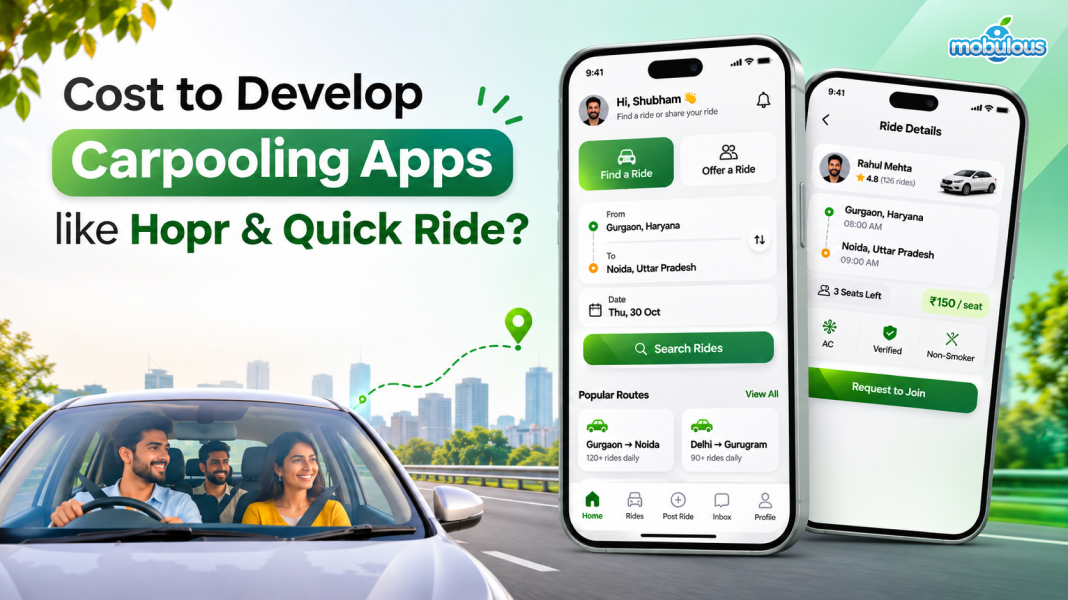
Every founder eyeing shared mobility asks the same thing: what is the real carpooling app development cost? For apps like Hopr and Quick Ride, 2026 budgets typically run from $10,000 to $150,000, depending on complexity, features, platforms, integrations, and team. This guide covers costs, features, technology, and timelines.
How Much Does Carpooling App Development Cost in 2026?
A realistic planning range for carpooling app development in 2026 is $10,000 to $150,000. A simple ride-matching MVP sits near the lower end, while an enterprise mobility platform with advanced automation, analytics, and integrations approaches the upper end. These are estimates, not fixed market prices.
| App Type | Estimated Cost (USD) | What It Generally Includes |
| Basic carpooling app | $10,000 to $25,000 | Rider and driver apps with registration, ride posting, search, booking, basic maps, notifications, and a simple admin panel |
| Mid-level carpooling app | $25,000 to $60,000 | Adds in-app payments, ratings, chat, fare splitting, recurring rides, document verification, and a fuller admin dashboard |
| Advanced carpooling app | $60,000 to $100,000 | Adds smart ride matching, real-time tracking, dynamic cost-sharing, wallets, SOS features, analytics, and scalable architecture |
| Enterprise-grade carpooling platform | $100,000 to $150,000+ | Multi-city or multi-tenant platform, corporate onboarding, custom integrations, advanced security and compliance, high-volume infrastructure |
The final carpooling app development price depends on project scope, technical requirements, third-party integrations, the location of the development team, and the engagement model.
How Do Apps Like Hopr and Quick Ride Work?
Unlike taxi apps, where a driver is dispatched to a passenger on demand, carpooling apps connect people who already plan to travel the same way. Drivers publish available seats on a route, and passengers search for matching rides, share the cost, and travel together.
1. User Registration & Profile Creation
Users sign up with a mobile number or email and build a profile. Verified profiles, such as those using work email checks, build trust between strangers sharing a vehicle.
2. Driver & Passenger Onboarding
Passengers usually need only a basic profile. Drivers add vehicle details and identity documents, which an admin team reviews before they can publish rides.
3. Ride Creation & Publishing
A driver enters the origin, destination, departure time, and number of free seats, and may set a price or recurring schedule. The ride then becomes visible to matching passengers.
4. Route Matching & Ride Discovery
The platform compares passenger and driver routes using geolocation and time windows, then ranks rides by proximity, timing, and detour. Better matching directly improves how useful the app feels.
5. Seat Availability & Booking
Each ride carries a seat count that updates as bookings arrive. Passengers request or instantly confirm seats, and the system blocks overbooking through real-time synchronization.
What Are the Must-Have Features of a Carpooling App?
A carpooling app is really three products: a passenger app, a driver app, and an administration panel. The panel handles verification, disputes, payouts, and reporting. Together, these essential features form the foundation of any launch-ready MVP, and each one affects effort and budget differently.
Passenger Features
- Sign-Up, Login, & User Profile Management
Lets riders register with phone, email, or social login and manage profiles. It builds trust early. Basic login is low cost, while OTP and identity checks add moderate effort.
- Ride Search and Pickup & Destination Selection
Passengers enter pickup, destination, and time to browse matching rides on a map. Clear search saves time and reduces drop-offs. Map integration and filtering logic add moderate development cost.
- Real-Time Ride Availability & Booking
Shows live seat availability and lets riders request or confirm a seat instantly. It prevents double bookings. Real-time synchronization needs careful backend design, so it raises cost noticeably.
- Fare Estimation & Cost-Sharing
Calculates each rider’s share of fuel and running costs from distance and seats. Transparent pricing avoids disputes. Simple per-kilometre rules are affordable, but flexible fare logic takes more engineering.
- In-App Chat, Notifications, & Emergency Assistance
Chat, push alerts, and an emergency button keep riders informed and safe. They support trust and retention. Notifications are inexpensive, while chat and SOS workflows add moderate to high effort.
Driver Features
- Driver Registration & Verification
Collects licence, ID, and background documents for admin approval. It protects passengers and the brand. Document upload is simple, but automated verification and review workflows increase cost.
- Vehicle Details Management
Stores make, model, plate number, colour, and photos. Riders can recognise the right car at pickup. This is a straightforward module, though document expiry reminders add some effort.
- Ride Creation & Scheduling
Drivers publish one-time or recurring rides with time, seats, and price. Recurring schedules suit daily commuters. Scheduling logic and edit or cancel rules add moderate complexity.
- Route & Destination Selection
Drivers set start, end, and optional stops on a map. Accurate routes drive better matching. Route calculation depends on mapping APIs, which add usage fees and integration work.
- Available Seat Management
Drivers declare seats, accept or decline requests, and close a ride when full. It keeps listings accurate. Basic controls are inexpensive, but automatic confirmation rules add logic.
What Advanced Features Impact Carpooling App Development Cost?
Advanced features turn a functional app into a competitive platform, but they also push up the budget. Each one should earn its place by solving a real user or business problem. Treat this section as a menu for later releases, not a checklist for version one.
1. AI-Powered Ride Matching & Smart Route Optimization
Machine learning can rank matches and suggest efficient routes once real ride data exists. It adds value at scale, not on day one, and typically adds high cost and complexity.
2. Real-Time GPS Tracking & Geolocation-Based Proximity Matching
Live tracking shows location and ETA, and proximity matching finds nearby riders. It boosts safety and confidence. Background location and map fees make it a mid-to-high budget item.
3. Dynamic Pricing & Intelligent Cost-Sharing
Pricing rules adjust fares by distance, demand, detours, or seat count. They keep contributions fair. Rule engines are moderately complex, and testing edge cases adds to cost.
Check local regulations before building this, since some regions restrict how much drivers may charge for shared trips.
4. Secure Payments, Digital Wallets, & Identity Verification
Payment gateways, wallets, and ID checks enable cashless trips and trusted users. They reduce friction and risk. Compliance requirements and third-party fees make this a high-impact cost area.
5. AI-Powered Fraud Detection & SOS Emergency Response
Models flag suspicious accounts or route deviations, and SOS alerts notify contacts or support. Valuable for safety and trust, though rule-based checks can suffice early. Full AI detection is costly.
AI is useful when you have enough ride data to learn from and a problem that simple rules cannot solve, such as matching thousands of daily commuters across overlapping routes. For a first launch in one city, well-designed rules and filters often perform just as well at a fraction of the cost.
How Much Does It Cost to Develop a Carpooling App Based on Complexity?
The table below compares the four development levels side by side so you can match your goals to a realistic budget and launch window. Timelines assume a dedicated team and timely feedback, and they typically include design, development, testing, and release.
| App Type | Estimated Cost | Development Timeline |
| Basic carpooling app | $10,000 to $25,000 | 2 to 3 months |
| Mid-level carpooling app | $25,000 to $60,000 | 3 to 5 months |
| Advanced carpooling app | $60,000 to $100,000 | 5 to 8 months |
| Enterprise-grade carpooling platform | $100,000 to $150,000+ | 9+ months |
Most first-time founders begin at the basic or mid-level tier, gather real ride data, and then invest in advanced features once demand is proven.
What Factors Affect Carpooling App Development Cost?
Two projects with the same feature list can end up with very different ride-sharing app development cost estimates. Platforms, design, backend, and integrations all shape the budget. The lowest hourly rate rarely produces the lowest total cost, because rework, delays, and weak architecture often cost more later.
1. Number of Platforms
Building for Android, iOS, and a web admin panel multiplies design, development, and testing effort. Cross-platform frameworks can reduce duplicated work, while native builds offer maximum platform control.
2. UI/UX Design Complexity
Standard layouts are faster to build. Custom animations, onboarding flows, and map-heavy screens raise design hours, but a clear interface can also build trust with first-time riders.
3. Feature Requirements
Every added feature, from chat to wallets, increases design, coding, and testing time. Prioritizing must-haves for launch and phasing the rest keeps the first release affordable.
4. Backend Architecture
Matching, seat updates, and tracking depend on a solid backend. Scalable, well-structured APIs cost more upfront but prevent expensive rebuilds when ride volume and cities grow.
5. Third-Party Integrations
Maps, payment gateways, SMS, identity checks, and push services each need integration and testing, plus recurring usage fees that belong in your operating budget.
What Technology Stack Is Required to Build a Carpooling App?
A modern carpooling app needs a mobile front end, a scalable backend, a reliable database, cloud hosting, maps, real-time messaging, secure payments, and strong security. The right combination depends on your market, budget, and team skills, so treat the table below as options rather than rules.
| Development Component | Recommended Technologies |
| Frontend / Mobile Development | Kotlin (Android), Swift (iOS), Flutter or React Native (cross-platform) |
| Backend Development | Node.js, Python (Django or FastAPI), Java (Spring Boot) |
| Database | PostgreSQL, MongoDB, Redis |
| Cloud and Infrastructure | AWS, Google Cloud, Microsoft Azure |
| Maps and Location Services | Google Maps Platform, Mapbox |
| Real-Time Communication | WebSockets, Firebase Cloud Messaging |
| Payment Integration | Stripe, Razorpay, other region-specific payment gateways |
| Security | OAuth 2.0, JWT-based authentication, encryption, secure API architecture |
Unsure which architecture fits your market? Choosing between native and cross-platform, or between Node.js and Python, is easier with an experienced partner.
Final Thoughts: Plan Your Carpooling App Development Cost with Confidence
Carpooling app development cost is not one number. It is the sum of the decisions you make about scope, platforms, technology, and team, and for most projects it falls between $10,000 and $150,000. Start lean, prove demand in one corridor or city, and add advanced features as real ride data comes in.
If you are ready to turn a carpooling idea into a working product, Mobulous can help you plan, design, develop, test, and launch it. With 12+ years of experience and 700+ apps delivered, the team offers custom carpooling app development services and solutions for startups and enterprises, and every engagement starts with an NDA. Contact Mobulous to share your concept and get a clear, project-specific estimate.
Frequently Asked Questions About Carpooling App Development Cost
Q1. How Much Does It Cost to Develop an App Like Quick Ride or Hopr?
Ans. Roughly $10,000 to $150,000, depending on scope. A lean MVP sits at the lower end, while platforms with smart matching, wallets, and multi-city scale cost more. The actual build budgets of Hopr and Quick Ride are not public, so get a scoped estimate for your own feature list instead.
Q2. How Much Does It Cost to Build a Carpooling App in India?
Ans. Projects in India often land in the lower half of the global ranges. Lower hourly rates than North America or Western Europe are the main reason, while scope, security, and integrations still drive most of the cost. A basic or mid-level app commonly falls between $10,000 and $60,000, but quality and long-term support matter as much as price.
Q3. How Long Does It Take to Develop a Carpooling App?
Ans. Most projects take 2 to 9 months or more. A basic app typically needs 2 to 3 months, a mid-level build 3 to 5 months, an advanced platform 5 to 8 months, and an enterprise system 9 months or longer. Design approvals, integrations, and device testing are the usual causes of delay.
Q4. Can I Build a Carpooling App with a Limited Budget?
Ans. Yes, if you scope carefully. Launch an MVP in one city or corridor, use a cross-platform framework, verify drivers manually at first, and add payments, tracking intelligence, and AI later. Mobulous offers MVP development services for founders who want to validate before they scale.
Q5. Is Flutter Suitable for Carpooling App Development?
Ans. Yes, in most cases. Flutter lets one codebase serve Android and iOS, works well with maps and push notifications, and can reduce cost and time. Heavy background location tracking may still need native code, so test it early. Mobulous offers Flutter app development alongside native Kotlin and Swift.
Q6. What Features Are Essential for a Carpooling App MVP?
Ans. A focused MVP needs six things:
- Registration with OTP verification
- Driver profile and vehicle verification
- Ride posting with seat count
- Route-based search and booking
- Simple fare display and cost-sharing
- Push notifications, an emergency contact option, and a basic admin panel
Chat, wallets, and AI matching can wait for version two.
Q7. How Do Carpooling Apps Make Money?
Ans. Mostly through commissions or service fees on shared costs. Other models include premium subscriptions, corporate partnerships where employers sponsor commuting, and partner promotions. The best choice depends on your market, user trust, and local rules on what drivers may charge, so validate it before building payment logic.
Q8. Do Carpooling Apps Require Real-Time GPS Tracking?
Ans. Not always at launch, but it becomes important quickly. Route-based matching can work without continuous tracking, yet live location and ETA improve safety and pickup coordination, and Quick Ride’s public materials highlight live tracking. Many founders add tracking in the second release once core demand is proven.
Q9. How Much Does It Cost to Maintain a Carpooling App After Launch?
Ans. A common planning guideline is 15 to 20% of the initial build cost per year. This covers bug fixes, OS updates, security patches, and small improvements, while cloud hosting, map and SMS fees, and payment charges are billed separately. Mobulous includes four months of free post-launch support as standard, with maintenance plans agreed before kickoff.
Q10. What Is the Difference Between Carpooling App Development and Ride-Hailing App Development?
Ans. Carpooling shares trips that are already happening, while ride-hailing dispatches dedicated drivers on demand. Carpooling apps center on route matching, seat inventory, scheduling, and cost-sharing. Ride-hailing apps center on instant dispatch, driver supply, surge pricing, and fleet operations, which usually add backend complexity and operating costs. Regulations and business models differ too.