LLM · RAG · Fine-tuning · Integration

LLM Development Company Built Around Your Data, Not a Vendor's Model

Mobulous is an LLM development company that designs, fine-tunes, integrates, and maintains LLM AI solutions around your company's data, workflows, and existing systems, not a generic chatbot wrapper. As a mobile app development company founded in 2013, our LLM developers help turn large language models into dependable business infrastructure — LLM application development and LLM product development at the model layer under broader generative AI development and AI app development work.

Teams comparing LLM development companies — including buyers looking for an LLM development company in USA delivery with our Newark, Delaware office — get free discovery calls. A mutual NDA comes before detailed discussion.

700+
Apps delivered
12+
Years · founded 2013
4.7★
Clutch · 103 reviews
500+ clients · 30+ countries
100+ experts
ISO 9001:2015 · ISO/IEC 27001:2022 · CMMI Level 3
Noida HQ · Newark, Delaware · Calgary, Alberta
Services

Our End-to-End Custom LLM Development Services

Off-the-shelf access to GPT, Claude, or Gemini answers generic questions well. Turning that access into a dependable business system — one that knows your data, follows your rules, and plugs into your existing stack — requires custom LLM development services and LLM integration services built around your actual workflows. When connected mobile clients are part of the release, the same team delivers them through our mobile app development services. Conversation design, chat channels, and human handoff for assistants are owned by the forthcoming AI chatbot page; this page stays on large language model development, retrieval, fine-tuning, and integration.

1. Custom LLM-Powered Solution Development

Many teams know they need “AI” somewhere in the product but haven't defined what problem it should solve. Mobulous starts with your use case — document intelligence, internal search, or customer-facing automation — then builds LLM app development and custom AI model development around it, not a demo that never reaches production. Broader AI application development packaging sits on that hub when the product is more than the model layer.

2. LLM Fine-Tuning Services

A general-purpose model trained on public text rarely understands your industry jargon or brand tone. Our LLM fine-tuning services adapt an existing foundation model to your domain using your own labeled examples, improving accuracy and consistency on the tasks that matter, without training a model from zero.

3. RAG Development & Retrieval-Augmented Generation

When answers must reflect your policies, product docs, or support history, we build retrieval-augmented generation pipelines: chunking, embeddings, vector retrieval, and citation-aware prompting so the model grounds responses in approved corpora instead of inventing detail.

4. LLM Integration with Enterprise Systems

An LLM that cannot read from or write to your CRM, ERP, ticketing system, or internal databases stays a novelty. We provide LLM integration services with the enterprise systems you already run, using APIs, secure connectors, and permission-aware retrieval, so the model acts on real business data instead of guessing. Productization into multi-tenant commercial software sits on our SaaS development company page when that is the delivery shape.

5. Domain-Specific LLM Development Services

Healthcare, finance, and legal teams cannot rely on a model that doesn't understand regulatory language or industry-specific risk. Our domain-specific LLM development services combine fine-tuning, curated retrieval corpora, and guardrails tailored to your sector, so outputs reflect the terminology, compliance boundaries, and accuracy bar your industry requires.

6. Private / Self-Hosted LLM Deployment

When data residency, cost-at-scale, or contractual limits block third-party APIs, we plan private and self-hosted LLM deployment on open-weight families such as Llama or Mistral — including inference serving, access controls, and operational monitoring — without claiming partnership status with any model vendor.

7. LLM Strategy & Roadmap Consulting

Not every business is ready to build. Some need clarity first: which use cases justify investment, which model approach fits their data and budget, and what governance needs to exist before launch. Our LLM strategy and roadmap consulting maps that path before a single line of code is written. Multi-step tool-using autonomy belongs on AI agent development; we keep this page on models, retrieval, and evaluation.

Escalation ladder

When to stop — and when to escalate — in LLM work

Most failed LLM budgets skip a rung. Climb only when the previous rung's stop rule fails under measured evals. Each rung stands alone: try it, stop if it works, escalate only with a specific failure mode.

Prompt engineering

Try this when
The task is narrow, examples fit in context, and answers do not require private corpora beyond what you can paste or template.
Stop here if it works, because
You avoid embedding pipelines, vector ops cost, fine-tune jobs, and a second model version to maintain. Prompt changes ship without retraining spend.
Only escalate past it when
Held-out prompts still invent facts, ignore required formats after retries, or need documents that will not fit context without retrieval.

RAG (retrieval-augmented generation)

Try this when
Answers must cite your policies, product docs, tickets, or knowledge bases that change faster than you can retrain.
Stop here if it works, because
You pay for indexing and retrieval ops, not for fine-tune cycles or custom weights. Corpus updates fix wrong answers without a new training run.
Only escalate past it when
Retrieval is correct but tone, jargon, or task format stays wrong across many examples — or latency/cost of large contexts is unacceptable after chunking and reranking.

Fine-tuning

Try this when
You have labeled examples that define domain language or output shape, and prompting plus RAG still miss consistency on those tasks.
Stop here if it works, because
You adapt an existing foundation model instead of owning training compute for a new base model. Eval sets and a single tuned checkpoint beat multiple research branches.
Only escalate past it when
No available base model meets privacy, license, or capability constraints even after fine-tuning — and you have budget and data for continued pretrain or heavy adaptation.

Train / adapt your own model

Try this when
You need weights you control end-to-end — residency, license, or capability gaps that fine-tuning an off-the-shelf base cannot close.
Stop here if it works, because
Further custom research does not reduce risk once evals and ops meet the bar; more training spend without a new failure mode is waste.
Only escalate past it when
You are not escalating past this rung on a typical product timeline. Revisit architecture, data quality, or product scope instead of another training budget.
Model families

Core Large Language Model (LLM) Variants

Large language models (sometimes searched as large language learning models) are not interchangeable. Each family trades off differently on accuracy, latency, cost, licensing, and data control, and the model right for a customer-support assistant is rarely right for a regulated document-analysis pipeline. Our LLM developers work across the families below for large language models development and AI model development, selecting or combining them based on your use case rather than defaulting to one vendor. Provider docs we commonly reference: OpenAI API documentation and Anthropic documentation — as build-with references, not partner claims.

1. GPT Series

OpenAI's GPT models are strong general-purpose reasoning and generation engines, widely used for chat, content, and coding assistants where broad capability and fast iteration matter more than self-hosting.

2. Claude

Anthropic's Claude models are known for careful instruction-following and long-context handling, making them a common choice for document review, summarization, and workflows where reliability under ambiguity matters.

3. Gemini

Google's Gemini models bring native multimodal reasoning across text, images, and structured data, and integrate closely with Google Cloud and Workspace environments for enterprises already on that stack.

4. Llama

Meta's Llama models are open-weight, allowing private hosting and fine-tuning without sending data to a third-party API, which matters for teams with strict data residency or cost-at-scale requirements.

5. Mistral Families

Mistral's open and commercial models are compact and efficient, delivering strong performance per compute dollar, often selected for latency-sensitive or self-hosted deployments.

6. DeepSeek

DeepSeek's open-weight models offer competitive reasoning performance at lower compute cost, appealing to teams that want strong capability without frontier-model pricing or vendor lock-in.

Technology landscape

LLM Technologies We Build With

Shipping a production LLM feature draws on a broader stack than the model itself. Mobulous works across foundation and open-source models, retrieval infrastructure, orchestration frameworks, and optimization techniques, choosing each layer for your latency, cost, and data requirements rather than defaulting to a fixed toolkit. Categories below are buyer decision aids — not a logo wall of delivered specialties. Runtime hosting for inference and data planes often sits alongside cloud application development when infrastructure ownership is in scope.

Foundation LLMs
OpenAI (GPT series) · Anthropic Claude · Google Gemini · Cohere Command
Open-source LLMs
Meta Llama · DeepSeek · Mistral Large · Microsoft Phi · Qwen
RAG & retrieval
Pinecone · Milvus · Qdrant · LangChain · LlamaIndex
Orchestration
LangGraph · CrewAI · Microsoft Semantic Kernel · Microsoft AutoGen — multi-step tool-using agent patterns are detailed on AI agent development.
Optimization
vLLM · QLoRA
Industry patterns

Custom LLM Development Solutions Across Industries

LLM use cases differ sharply by industry: a fintech compliance assistant and a hospital's clinical documentation tool solve different problems with different risk tolerances, and not every workflow needs an LLM. Below are the patterns we see most often. Broader product packaging and stage-gates sit on product development company when the question is roadmap ownership rather than model layer design.

1. Generative content workflows

Marketing and content teams spend hours drafting, localizing, and repurposing copy. LLM-powered generation drafts, summarizes, and adapts content across formats, cutting production time while keeping a human in the review loop.

2. FinTech

Compliance teams drown in policy documents and transaction alerts. LLMs summarize regulatory text, draft audit-ready reports, and flag anomalies in plain language, helping analysts review more cases without missing nuance.

3. Healthcare

Clinicians lose hours to documentation instead of patients. LLMs, deployed within privacy and audit controls, draft clinical notes and summarize patient histories, keeping a clinician in every decision.

4. Ecommerce

Shoppers abandon searches when product discovery feels generic. LLM-driven recommendation and conversational search understand intent beyond keywords, guiding customers to relevant products without a full catalog rebuild.

5. Transport

Dispatch and customer service teams field repetitive routing and status questions. LLM-based assistants answer rider and driver queries, summarize incident reports, and support dispatch decisions using live operational data.

6. Logistics

Fragmented shipment data slows exception handling. LLMs read delivery notes, customs paperwork, and tracking updates to summarize exceptions and draft customer updates automatically.

7. E-Learning

Learners disengage when content isn't adaptive. LLM-powered tutoring assistants answer questions in context, generate practice material aligned to a curriculum, and summarize progress for instructors without replacing human teaching.

8. Real Estate

Buyers ask the same qualifying questions across hundreds of listings. LLM real estate development patterns use assistants that answer property questions from your listing data, pre-qualify leads conversationally, and summarize inquiries for agents — grounded retrieval, not generic chat.

9. Food Delivery

Support queues fill with order-status and refund questions. LLM-based chat handles routine order queries and refund logic against your policies, freeing support staff for disputes that need judgment.

10. Travel

Itinerary questions and booking changes overwhelm small support teams. LLM assistants answer policy and itinerary questions grounded in your booking data, and draft personalized trip suggestions based on traveler preferences.

11. On-Demand

On-demand platforms juggle providers, customers, and disputes at once. LLM-powered triage summarizes complaints, matches provider capacity to demand patterns, and drafts resolution messages.

12. Wellness

Wellness apps need to personalize without sounding robotic. LLMs generate tailored workout or mindfulness guidance from user history and goals, and summarize progress in plain language.

13. Media

Newsrooms and publishers process more content than editors can review manually. LLMs draft summaries, generate metadata and tags, and assist translation or localization, with editorial review before anything publishes.

14. Social

Moderation queues grow faster than human reviewers can clear them. LLMs pre-screen flagged content against community guidelines and draft contextual responses, letting moderators focus on genuinely ambiguous cases.

15. SaaS

Support tickets and documentation gaps slow every SaaS team down. LLM-based in-app assistants answer product questions from your docs and changelogs, deflecting repetitive tickets while escalating complex issues to humans.

16. Agriculture

Farm advisories are often generic and arrive too late. LLMs can turn agronomic data, weather reports, and crop records into plain-language guidance, though impact depends heavily on data quality and field connectivity.

Process

Our Strategic Custom LLM Development Process

A credible LLM development process — the practical LLM development life cycle from strategy through MLOps — balances technical rigor with business judgment: which model, how much data preparation, what evaluation bar, and how it fits your existing systems. Below is how Mobulous structures custom LLM development and LLM in software development engagements from first conversation to production deployment. Teams learning LLM development can use the same sequence as a checklist before funding heavier rungs.

1. Discovery & LLM Strategy

We map your workflows, data sources, and success criteria to decide whether an LLM is the right tool for the job. A wrong-fit use case wastes budget before development starts. You leave with a scoped use case and a realistic model recommendation.

2. Data Engineering & Corpus Design

Your LLM is only as useful as the data behind it. We assess data volume, quality, and access controls, then build the retrieval corpus or fine-tuning dataset it needs, catching gaps early rather than letting them surface as hallucinations later.

3. Architecture Selection & Model Design

We choose between a hosted foundation model, a fine-tuned open-source model, or a hybrid approach based on your accuracy, latency, privacy, and cost requirements. Getting this decision right up front avoids expensive rework. You get an architecture matched to your actual constraints, not a default.

4. Model Training & Fine-Tuning

Where fine-tuning is the right call, we train on your curated data using techniques suited to your compute budget, then validate against held-out examples. This improves domain accuracy and consistency without inflating cost, giving you a model measurably better than a generic baseline on your tasks.

5. Evaluation, Safety & Optimization

Before anything ships, we test for accuracy, hallucination rate, bias, and edge-case behavior, then tune prompts, retrieval, and guardrails against those results. Skipping this step is how AI pilots fail quietly in production. You get documented evaluation criteria and predictable behavior under real use. Governance references include the NIST AI Risk Management Framework.

6. Integration, Deployment & MLOps

We connect the model to your applications, CRM, or internal tools, deploy it into your infrastructure, and set up monitoring for drift, cost, and accuracy over time. This is where most in-house AI projects stall. You get a live system with a maintenance plan, not a one-time deliverable.

Why Mobulous

Why Choose Mobulous for Custom LLM Development

How to choose an LLM development company is a decision about process and evidence, not a “best LLM development company” label. Mobulous is an ISO 9001:2015 and ISO/IEC 27001:2022 certified, CMMI Level 3 appraised LLM software development company with more than a decade of delivery experience, and skilled LLM developers who already ship retrieval-based systems and model integrations into live products — the bar enterprise LLM development companies should clear on data handling and post-launch ownership. Broader multimodal GenAI framing sits on our generative AI development company hub; tool-using autonomy sits on AI agent development.

1. Customized LLM Solutions

We don't resell a single chatbot template. Every engagement starts with your workflows and data, then matches model choice, fine-tuning depth, and integration scope to what your business actually needs, so you aren't paying for capability you'll never use, or missing capability you actually require.

2. A Structured Path to Production

LLM pilots often stall in endless experimentation. Our process moves from a scoped use case to a working, evaluated system on a timeline agreed at kickoff, with milestones you can track, rather than an open-ended research engagement with no delivery date.

3. Engineered for Cost-Efficient Inference

Unmanaged LLM usage gets expensive fast through repeated large-context calls. We control inference cost through model right-sizing, caching, prompt optimization, and routing simpler queries to smaller models, so running costs stay predictable as usage scales instead of climbing unnoticed.

4. Multi-Modal and Hybrid Model Capabilities

Not every problem is solved by text alone. We build solutions that combine LLMs with computer vision, structured data, and multiple model families in one workflow, such as OCR feeding a document-understanding pipeline, so the system matches the real shape of the problem.

5. Explainability, Transparency & Responsible AI

A model that can't explain its output is hard to trust in a regulated workflow. We build in source citation for retrieval-based answers, confidence signals, human-in-the-loop review points, and logging, so stakeholders can see why the system produced a given answer.

6. Security-First Data Handling

Your proprietary data shouldn't silently become someone else's training set. We architect retrieval and fine-tuning pipelines with data isolation, access controls, and contractual limits on how vendor APIs use your data, under the same ISO/IEC 27001:2022-aligned security practices that govern the rest of our delivery work.

Client voice

Words From Our Clients

★★★★★

Excellent app development company delivering high quality mobile apps. They render professional services to their customers. I am happy with that team

Loveth Kink
B4U Television · Verified GoodFirms · 5.0
Verified on GoodFirms →
★★★★★

Quite happy with their pre and post-launch support.

Gaurav Uppal
Map My Meet · Verified GoodFirms · 5.0
Verified on GoodFirms →

Mobulous rates 4.7/5 on Clutch across 103 verified reviews. Clutch → · GoodFirms →

LLM insights

Supporting reading on AI cost, edge AI, and automation

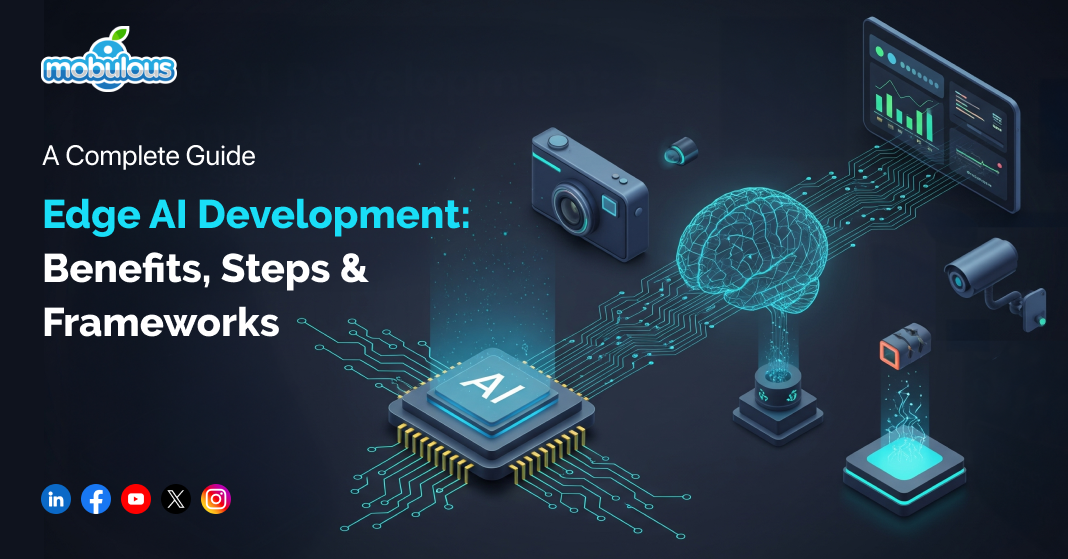
Articles that sit beside LLM development decisions: AI app cost ranges, edge deployment patterns, and RPA when automation is the better fit than a language model.

FAQ

Frequently Asked Questions

What is LLM development?

LLM development is the engineering work of turning large language models into reliable software: prompt design, retrieval-augmented generation, fine-tuning, LLM integration services, evaluation, and operations. It is not the same as buying API access alone. Custom LLM development services wrap models around your data, permissions, and workflows so outputs stay accurate and governable in production.

How to develop an LLM from scratch?

How to develop LLM from scratch usually means training a foundation model on massive corpora — compute and data budgets few businesses need. Most teams should fine-tune an existing model or build retrieval and application layers instead. We will tell you honestly which path fits your project before you fund a from-scratch training program.

How to develop a LLM model for a product?

How to develop a LLM model for production follows the escalation ladder on this page: prove prompts, add RAG when private docs matter, fine-tune when tone or task format still fails, and only then consider heavier adaptation. Pair that with evals, safety checks, and integration into the systems users already open — that is LLM application development, not a notebook demo.

How to build a custom LLM?

How to build a custom LLM in practice means scoping the use case, preparing a corpus or labeled set, choosing hosted vs self-hosted weights, implementing RAG and/or fine-tuning, evaluating on held-out tasks, then deploying with monitoring. “Custom” is about your data and constraints — not inventing a new foundation model by default.

How to choose an LLM development company?

How to choose an LLM development company: ask for stop rules (prompt vs RAG vs fine-tune), IP and data-use terms, evaluation methods, and who owns architecture after kickoff. Compare enterprise LLM development companies on evidence and process, not “best” labels. Prefer partners who separate model-layer work from chatbot channel design and agent orchestration when those are different problems.

How much does LLM development cost?

How much does LLM development cost depends on model choice, data preparation, fine-tuning needs, integration complexity, and ongoing inference volume — not a fixed package price. Simple integrations using an existing API can start around $5,000, while enterprise platforms with custom fine-tuning and multiple integrations can exceed $1 million. We provide a tailored estimate after scoping your project.

What LLMs do you have experience in?

We work across major foundation and open-source model families, including OpenAI's GPT models, Anthropic's Claude, Google's Gemini, Meta's Llama, Mistral, and DeepSeek. Model choice depends on your accuracy, latency, privacy, and cost requirements. We aren't tied to a single vendor and recommend whichever fits your use case.

How do you protect our data?

We use access controls, data isolation between retrieval and fine-tuning pipelines, and contractual limits on how third-party model providers may use your data. Our information security practices align with ISO/IEC 27001:2022, and we sign NDAs and data processing agreements before any sensitive data changes hands.

What is your approach to preventing hallucinations?

We ground responses in your own data through retrieval rather than relying on a model's internal knowledge alone, add source citations where possible, and set confidence thresholds that trigger human review or a fallback response instead of a confident guess. Evaluation happens before launch, not after.

How will you integrate the LLM with our enterprise tools?

We connect to your CRM, ERP, ticketing, or internal databases through APIs, secure connectors, or middleware, respecting existing permission structures so the model only accesses data a given user is authorized to see. Integration scope is defined during discovery based on the systems you already run.

How does Mobulous handle support and maintenance?

LLM systems need monitoring for prompt drift, model deprecation, rising costs, and degrading accuracy over time, not just bug fixes. We offer maintenance plans covering monitoring, retraining or prompt updates, and model version upgrades, so performance doesn't quietly decline after launch.

Can custom LLMs integrate with existing business systems?

Yes. LLMs are commonly integrated with CRMs, ERPs, helpdesks, document management systems, and internal databases through APIs or middleware. Integration depth depends on what those systems expose and what security or compliance controls govern access, which we assess during discovery.

What is the typical timeline for custom LLM development?

Timelines vary widely with scope. A narrow chatbot built on an existing model can launch in about a week, while a fine-tuned, multi-system enterprise deployment with compliance review can take up to 9 months. We share a milestone plan after discovery so you know what to expect.

Build with Mobulous

Build Custom LLM Solutions Around Your Data

Whether you need prompt-level prototypes, RAG against private corpora, fine-tuning, private LLM deployment, or help developing LLM applications for enterprise workflows, Mobulous can own LLM development from strategy through evaluation and MLOps. Free discovery calls. Mutual NDA before deep detail. Offices in Noida; Newark, Delaware (USA); and Calgary, Alberta.

  • 700+ apps delivered · 12+ years · founded 2013
  • 4.7/5 Clutch (103 reviews) · ISO 9001:2015 · ISO/IEC 27001:2022 · CMMI Level 3
  • Source code and IP transfer on delivery · structured post-launch support
Talk to Our LLM Development Experts →

Estimate your LLM project

Related: generative AI development company, AI app development, AI agent development company, AI and machine learning development, SaaS development company, mobile app development services, estimate your project.