Data before the model
Volume, coverage, label quality, and leakage risk decide whether training is possible. Messy, sparse, or unlabelled data needs a data plan first, not a framework debate.
This page is about building and running models: data readiness, selection, evaluation, deployment, and drift. Product AI features live on our AI app development company page. Mobulous is a mobile app development company that treats machine learning as engineering with failure modes, not a logo wall of frameworks.
Most agency ML pages list use cases. Production work is messier: sparse labels, leakage in train splits, models that look accurate offline and fail on the first week of live traffic, and cost spikes when every request hits a large model. A machine learning development company that has put models into products knows those break points by name.
AI app development owns shipping product surfaces that use AI features. This page owns the engineering underneath: whether a model is feasible, how you prove it works, how you serve it, and when a rule still beats a neural net. That distinction keeps the cluster honest for teams searching machine learning app development company and ml app development company terms.
Volume, coverage, label quality, and leakage risk decide whether training is possible. Messy, sparse, or unlabelled data needs a data plan first, not a framework debate.
A logistic baseline or a well-tuned tree often beats a deep model on small tabular sets. Complexity is earned when the error pattern demands it.
Holdout accuracy is not production truth. Overfitting shows up as confident wrong answers on rare segments, seasonal drift, and silent degradation after a content or user mix shift.
Stable rules, thresholds, and heuristics outperform a model when data is thin, the decision is deterministic, or being wrong is more expensive than being slightly less clever.
Work these five gates in order. If a gate fails, pause the model build and fix the gate. Skipping ahead produces demos that never survive production traffic.
If the answer is a fixed rule, a lookup, or a deterministic workflow, prediction adds cost without learning. Write the decision you need and whether history actually contains signal for it.
Gate fails if the outcome is already known from policyEnough examples across the segments that matter in production, not just the easy majority class. Rare but costly cases must appear in the training and evaluation sets.
Gate fails if critical segments have almost no examplesLabels must match the production definition of success. Ambiguous, delayed, or conflicting labels poison every model choice downstream. Plan who labels, how disagreements resolve, and how often labels refresh.
Gate fails if “ground truth” cannot be defined the same way twicePrecision, recall, calibration, latency, and cost per decision need numbers the business will accept. “Make it smarter” is not a criterion. Tie the metric to a user or ops outcome.
Gate fails if nobody can say what “good enough” meansEvery model errs. Decide what happens on false positives and false negatives: human review, fallback rule, or blocked action. Without a failure path, deployment is unsafe even when average metrics look fine.
Gate fails if errors have no owned response pathPass the gates, then choose stack and serving. For product AI surfaces after the model path is clear, continue on AI app development.
Machine learning app development services worth buying cover the full path, not a notebook that never ships. Below is the engineering sequence we use when a brief clears the readiness gates.
Start with a data contract: sources, freshness, PII boundaries, and join keys. For sparse data, prefer stronger features and simpler models over synthetic volume theatre. For unlabelled data, decide whether human labelling, weak supervision, or an off-the-shelf API removes the need to train at all.
Baseline first. Compare a simple model to a complex one on the same split. Use an API when the task is generic and your data does not justify training. Train when your domain labels, constraints, or latency budget make a vendor model a poor fit.
Lock the split before tuning. Watch for leakage through IDs, timestamps, and post-outcome features. Evaluate by segment, not only global accuracy. Overfitting in production looks like strong offline scores and brittle live behaviour on new users or rare classes.
Choose on-device when privacy, offline use, or per-request cloud cost dominates. Choose server when models are large, features are shared, or you need central monitoring. Latency and cost per inference belong in the acceptance criteria, not as afterthoughts.
Version data and models together. Monitor prediction distributions, not only uptime. Define retrain triggers for drift, label delay, and business metric drops. Without monitoring, a launched model is a decaying asset.
Heuristics, thresholds, and expert checklists beat ML when history is short, the environment is heavily regulated, or the cost of a wrong automated decision exceeds the value of a small accuracy gain.
Tools matter after the readiness gates pass. The list below is how teams usually choose, not a claim that every tool is a delivered specialty. Pick for iteration speed, serving constraints, and ops maturity.
PyTorch suits research iteration and custom architectures. TensorFlow Serving suits teams that already standardise on TensorFlow for production serving. Scikit-learn remains the right first stop for many tabular problems.
SageMaker, Vertex AI, and Azure ML trade control for managed training and endpoints. They help when your team wants cloud ops bundled; they cost more when you only need a simple batch job and a small API.
ONNX helps when you need portable inference across runtimes. Redis-backed feature stores and Feast-style patterns matter when online features must stay consistent with offline training. Skip them until feature drift is a real failure mode.
MLflow and Weights & Biases help when experiments multiply and you need reproducible runs. They do not replace a clear success metric or a production monitoring plan.
Named products where AI sits in the product surface: recommendations, matching, generation, moderation, and partner search. Lab prototypes are listed separately and are not claimed as client case studies.
Client: UnoDogs Pvt Ltd. Dog fitness management with activity monitoring, exercise and diet recommendations, calories and distance, ideal weight and goals. Machine learning powers tailor-made fitness programmes for pets.
Domain: Premium eco-conscious car wash delivered to the customer parking spot, with waterless cleaning, booking, real-time tracking, transparent pricing, and employee tools for scheduling, training, checklists, and earnings. AI generates wash work and matches jobs to available people so the right person gets the job.
Domain: Healthcare. Tele-video cancer consultation platform connecting patients and families with globally registered oncologists for medical advice, second opinions, and treatment guidance. AI-based doctor recommendation and AI report generation support the consultation flow.
Domain: Logistics. EV delivery booking for reliable, cost-effective, lower-emission transport. AI-based logistics partner search sits in the matching flow. Recently launched in the EV space with 5,000+ drivers operating in Delhi-NCR, 10K+ active customers, and 1,000+ daily rides.
Domain: Hiring portal and app (agencies and candidates). Full design and development by Mobulous, with a 1 million user base supported and maintained for 5 years. AI-based job matching between employers and job seekers. Client is a funded organisation with approximately USD 4 million in funding.
Domain: School and college social media. Supportive, distraction-free social ecosystem for students, teachers, professionals, and institutions. AI-based social feed, AI-based recommendations, and AI-based removal of inappropriate content.
An ml software development company engagement here is scoped as readiness assessment, model path, serving constraints, and monitoring, not a use-case carousel. Pair it with AI app development for product features, custom app development for the surrounding system, and mobile app development when the client is a phone or tablet surface.
Gate the problem, inventory data, define labels and success metrics, and decide whether training, an API, or a rule is the honest next step.
Baselines, holdout discipline, segment metrics, and a serving plan that names latency and cost per inference before launch.
Versioning, drift signals, and owned response paths when predictions degrade. MLOps is part of the build, not a slide after go-live.
Deeper reading: How to build AI infrastructure and How to build an AI-powered app.
Machine learning insights
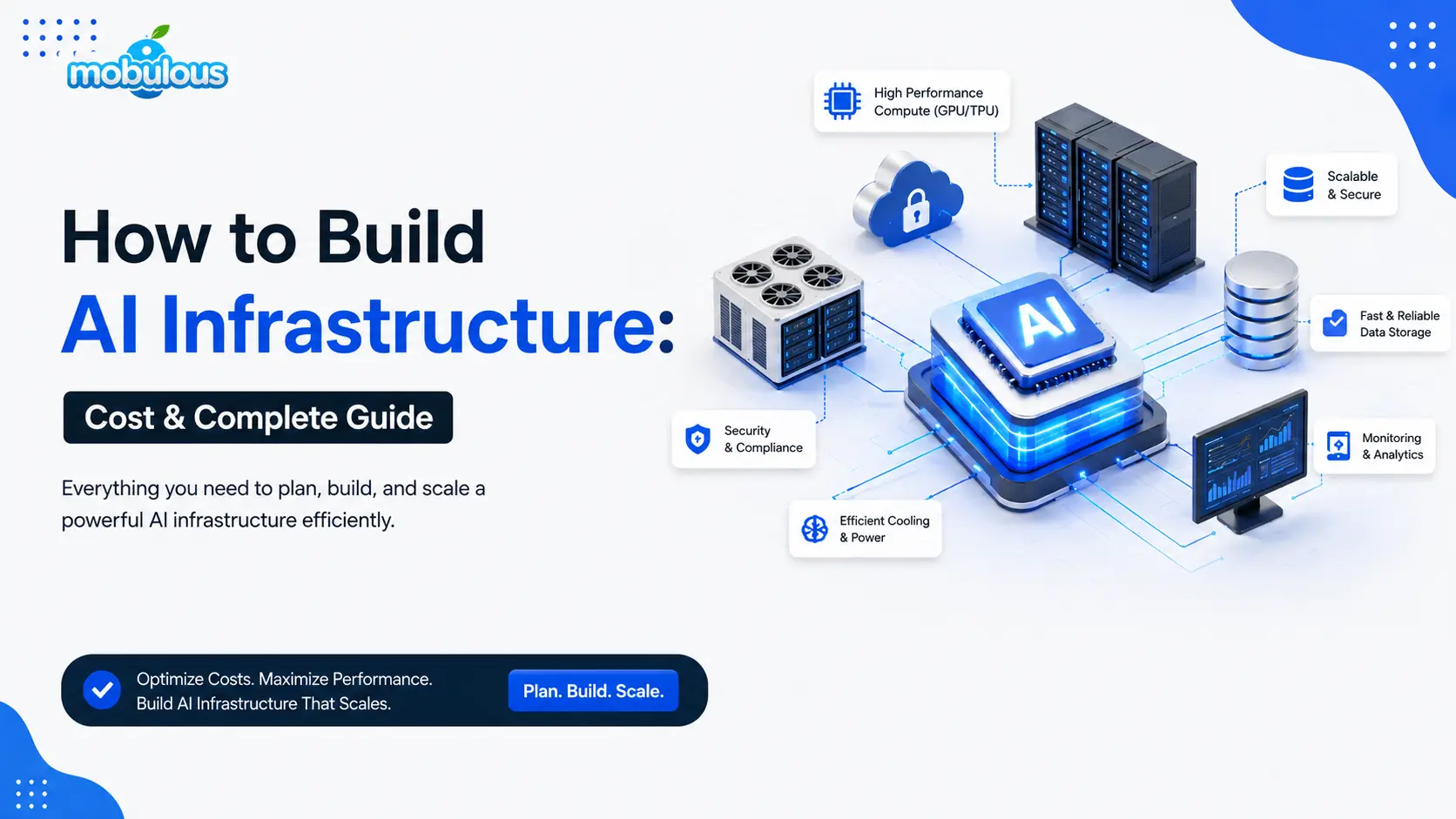
Cost and architecture notes for the infrastructure underneath AI and ML systems, before you scale training or serving.
Continue Reading

A business guide to scoping AI in a product without confusing a feature demo with a maintainable model path.
Continue Reading
How to shortlist AI partners on shipped systems and clean execution, not demo decks alone.
Continue Reading
"Their technical expertise and creativity were commendable. Website traffic up 40%, booking inquiries up 25%."
Verified on Clutch →"They had the ability to understand our unique needs and goals and translate them into a user-friendly website design."
Verified on Clutch →"They exceeded our expectations and paid extraordinary attention to detail."
Verified on Clutch →Mobulous rates 4.7/5 on Clutch across 103 reviews. View the full Clutch profile →
AI app development covers product features users see. This page covers whether a model is feasible, how it is evaluated, how it is served, and how it is monitored. Many programmes need both; they are not the same brief.
When data is too thin, labels are unreliable, the decision is deterministic, or a wrong automated call is more expensive than a slightly less clever rule. We say so before training starts.
No. Frameworks and cloud ML platforms are client choices discussed after readiness gates. We do not list TensorFlow, PyTorch, SageMaker, Vertex AI, or similar as a delivered logo wall on this page.
Five gates: whether prediction is needed, data volume and coverage, label trust, a measurable success criterion, and tolerance for being wrong. Fail a gate and the model build waits.
On-device when privacy, offline use, or per-request cloud cost dominates. Server when models are large, features are shared, or central monitoring matters. Latency and cost per inference belong in acceptance criteria.
The shipped products section mirrors the AI page: UnoDogs, Bubbl Club, iOnco Solutions, iLine, JobYoda, and KonnectX. Lab prototypes stay separate and are not claimed as client case studies.
Version data and models, monitor prediction distributions and business metrics, and define retrain or rollback triggers. Launch without monitoring is not a finished ML engagement.
Mobulous is a machine learning development company focused on data readiness, model selection, deployment, and drift monitoring, and we say when ML is the wrong answer. We have delivered 700+ apps since 2013 from Noida (with offices in Newark, Delaware, and Calgary, Alberta), and rate 4.7/5 on Clutch (103 reviews).
Continue on AI app development, custom app development, mobile app development, or AI infrastructure guide.
Need a cost ballpark first? The 90-second estimator gives a range before the call.
Related reading: app development company, including AI app development services, including mobile app development services.