What we build
Swift, Kotlin, and Jetpack Compose builds from a native app development company trusted across India, the USA, and the Middle East.
Explore Our Specialized App Development Services
Native Apps We Ship
Highlights from Mobulous—your native mobile app development company for Swift & Kotlin excellence. 700+ apps delivered with a 4.7/5 Clutch score.
Mobile app development cost
Get your exact development cost in 60 seconds with our free app cost estimator
We respond to every request personally · NDA protected · Free consultation
Featured In
Our Tech Stack
Our expert mobile app developers use the latest technologies to build secure and high-performance mobile apps. We carefully select frameworks and languages to deliver optimal results for Android, iOS, and cross-platform projects.
Industries We Serve
Every vertical—from fintech to logistics—benefits when native app development unlocks biometrics, AR, or offline intelligence. Mobulous maps those signals to Swift or Kotlin roadmaps so your native mobile app development company engagement stays outcome-focused, not template-driven.
How We Work
The same blueprint Mobulous applies across 700+ shipped apps—now tuned for Xcode and Android Studio pipelines so native milestones stay auditable.
We pair Apple and Google guidelines with your KPIs to lock languages, modules, and CI targets before native coding begins.
Platform-native components, motion, and accessibility reviews keep SwiftUI and Compose prototypes faithful to production.
Proof-of-concept hooks for push, maps, payments, or ML ensure APIs behave before full native implementation.
Swift, Kotlin, and Jetpack libraries implemented with feature flags, modular architecture, and static analysis in CI.
XCTest, Espresso, snapshot, and device farm passes covering biometric, offline, and store submission scenarios.
Phased App Store and Play releases, crash analytics, OS migrations, and SLA-backed iterations from your native app partner.
Why Mobulous
Mobulous pairs certified Swift, Kotlin, and Jetpack Compose expertise with the accountability you expect from a native mobile app development company—covering India, the USA, and the UAE with 12+ years of delivery muscle.
We respond to every request personally · NDA protected · Free consultation
Trusted By
Fortune-listed teams and fast-moving startups rely on Mobulous for premium native mobile apps—proving our native app development DNA across 40+ marquee logos.
Latest Updates
21 April 2025
Mobulous is highly delighted to share that it has been classified as the best mobile app development company of 2025 and has received the coveted India Business Award (IBA) by Bipasha Basu.
Continue Reading
20 March 2026
Here are the companies that consistently deliver innovative and scalable solutions.
Continue Reading
11 March 2026
Poultryfy: Track Rates, Manage Farms & Connect with Vets
Continue Reading
25 Feb 2025
Mobulous has been honored by ABP LIVE for being awarded the highly praised “Global Icon Award 2025” by Corporate Connect Global Magazine.
Continue Reading
24 Dec 2024
Mobulous’ journey is extremely inspiring which once started from humble beginnings as a small group of visionaries to becoming a renowned global leader in the industry, creating robust apps for iOS and Android devices.
Continue Reading
24 Dec 2023
Mobulous Technologies is excited and proud to announce that we have been named as both a Clutch Global Winner 2023 and Clutch Global Winner 2023 for unmatched services we offer to our clients.
Continue Reading
Deep dive into native app development—from Swift & Kotlin stacks to privacy and performance. Use this guide to evaluate a native mobile app development company, compare approaches, and plan releases that feel truly platform-native on iOS and Android.
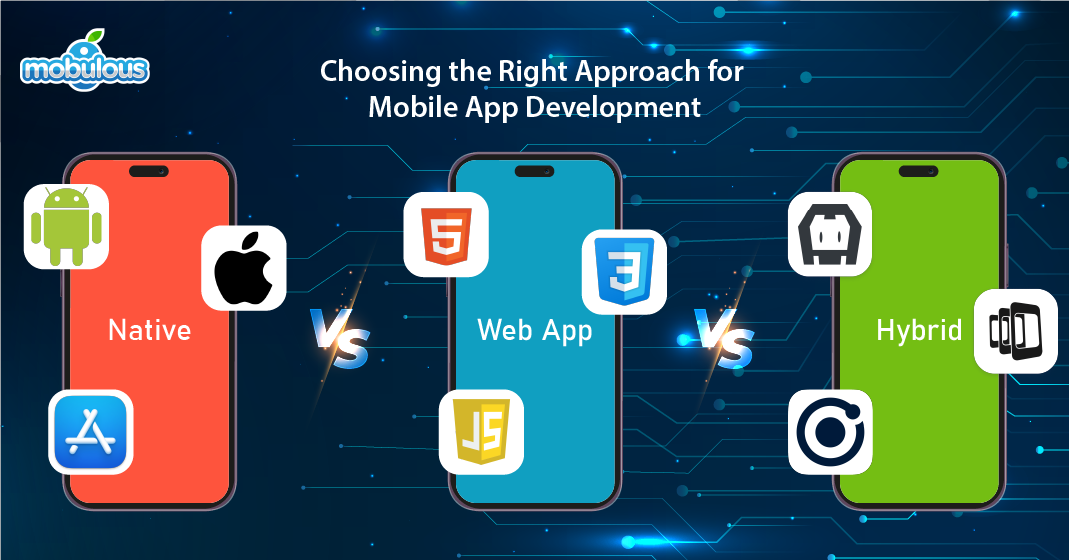
Native mobile app development refers to the creation of applications specifically designed for a particular operating system, like iOS or Android. These apps are built using platform-specific languages and tools, such as Swift for iOS and Java/Kotlin for Android. The term "native" indicates that the app is optimized to seamlessly integrate with the features and capabilities of the targeted device.
In contrast, hybrid app development involves using web technologies like HTML, CSS, and JavaScript to create applications that can run on multiple platforms. While hybrids offer cross-platform compatibility, they may not fully leverage the native features of each device.
The primary difference lies in optimization and performance. Native apps provide a tailored experience, taking advantage of the unique functionalities of a device, resulting in better performance and user experience. Hybrid apps, on the other hand, sacrifice some optimization for the convenience of running on different platforms with shared code.
If you're looking for top-notch performance and an app that dances seamlessly with a specific operating system, partnering with an experienced native app development company is the smart move. Their native app development expertise ensures your build feels purpose-built for each device.
Native mobile app development comes with a bundle of perks. First off, you get optimized performance that makes your app run like a well-oiled machine. The user experience is as smooth as it gets, ensuring your audience stays engaged. Plus, native apps give you a backstage pass to a broader range of device capabilities, unleashing the full potential of your app.
Native mobile app development is a powerhouse of benefits. To begin with, you enjoy optimized performance, making your app run seamlessly. The user experience is exceptionally smooth, ensuring your audience stays captivated. Moreover, native apps provide a backstage pass to a broader range of device capabilities, unlocking your app's full potential.
Now, diving into specifics, the key benefits of native mobile app development are:
1. Optimized Performance : These apps are tailor-made for specific operating systems like iOS or Android, allowing them to harness the device's full potential. This results in superior performance, faster loading times, and an overall smoother user experience.
2. Seamless User Experience : Native apps leverage the native UI elements and design patterns of the target OS, offering a consistent and intuitive user experience. This familiarity enhances user interaction and navigation.
3. Access to Wider Device Capabilities : Direct access to the device's hardware and software features opens doors to immersive experiences, from augmented reality to location-based services and other device-specific functionalities.
4. Security and Reliability : Built on robust native platforms, these apps provide a more secure development environment, reducing the risk of vulnerabilities and ensuring reliability.
5. Offline Access and Data Storage : Native apps can be designed to work offline, allowing users to access specific features and data without an internet connection—ideal for continuous access in various scenarios.
6. Mature Development Ecosystem : Native development platforms boast mature ecosystems with a large developer community, extensive documentation, and a wealth of third-party libraries. This facilitates collaboration, problem-solving, and efficient development.
7. Scalability and Future-Proofing : Native apps are inherently more scalable and adaptable to future OS changes. Their core foundation ensures compatibility and integration with new features and technologies.
In essence, native mobile app development is a strategic choice for delivering top-notch, high-performance, and secure mobile experiences.
Native mobile app development is the most suitable choice for businesses and projects when prioritizing top-notch performance, a seamless user experience, and harnessing the full spectrum of device capabilities. Dive into specific scenarios where native development truly stands out:
Performance-Critical Applications : Native apps shine in scenarios demanding exceptional responsiveness, smooth animations, and minimal latency. Their direct access to the device's hardware ensures optimized code execution.
Complex Features and Integrations : When your app requires intricate features, deep integration with device functionalities, or seamless data synchronization across platforms, native development offers the flexibility and control needed.
Rich User Experiences : Native apps excel in delivering immersive and engaging user experiences by leveraging native UI elements, design patterns, and device-specific interactions.
High-Security Requirements : For applications handling sensitive data or financial transactions, native apps provide a more secure environment with tight integration into the device's security features.
Long-Term Scalability and Maintenance : Native development lays a robust foundation for apps expected to evolve over time, supporting future OS advancements and ensuring scalability.
Examples of industries where native mobile app development services are often preferred include finance (banking, payment apps), gaming (high-performance games, AR games), healthcare (patient monitoring, telemedicine), transportation (ride-hailing, logistics), and enterprise productivity (project management, CRM systems).
In summary, when your app's success hinges on factors like performance, user experience, device capabilities, security, and long-term scalability, opting for native mobile app development services is the strategic choice.
Choosing the right native mobile app development company is very important for the success of your project. Here are the essential factors to consider when making your decision right:
Experience : Look for a company with a proven track record in native mobile app development. Experience often correlates with expertise and the ability to handle diverse project requirements.
Expertise : Ensure the company has expertise in the specific platform you're targeting, whether it's iOS, Android, or both. Platform-specific knowledge is crucial for optimal app performance
Portfolio and Case Studies : Review the company's portfolio to gauge the quality of their previous work. This provides insights into their capabilities, design aesthetics, and the types of apps they've developed. Case studies provide in-depth insights into their problem-solving approach and client satisfaction.
Communication : Effective communication is vital for a smooth development process. Choose a company that maintains clear and transparent communication, keeping you informed at every project stage. Evaluate the company's responsiveness, willingness to address concerns, and ability to collaborate seamlessly with your team.
Development Methodology and Process : Understand the company's development methodology, encompassing planning, design, coding, testing, and deploying native mobile apps. Ensure their process aligns seamlessly with your project requirements and expectations.
Project Management and Timeline : Assess the company's project management capabilities, focusing on their ability to craft detailed project plans, track progress, manage risks, and adhere to timelines.
Technical Resources and Team : Evaluate the company's team of developers, ensuring they possess the necessary skills, experience, and certifications for your project's unique requirements.
Cost and Value Proposition : Consider the company's pricing structure and compare it to industry standards. Evaluate whether their proposed value proposition, including Native Mobile App Development expertise, aligns with your budget and expectations.
Client Reviews : Check client reviews and testimonials. Real feedback from previous clients provides valuable insights into the company's reliability, professionalism, and overall client satisfaction in the realm of Native Mobile App Development.
Industry Recognition and Awards : Investigate if the company has received any industry recognition or awards, indicating their expertise and reputation in the Native Mobile App Development domain.
Company Culture and Values : Ensure the company's culture and values align with your own. A collaborative and values-driven environment fosters a positive working relationship and contributes to the success of your Native Mobile App Development project.
By thoroughly evaluating these factors, you increase the likelihood of finding a native mobile app development company that aligns with your project goals and expectations, ensuring a successful and high-quality outcome.
The journey through native mobile app development is a meticulously orchestrated process, ensuring the seamless delivery of a top-tier mobile application. Let's delve into the vital phases that make this journey a success:
Requirement Gathering and Analysis : Clearly define the native mobile app's purpose, target audience, features, and functionality.
Feasibility Assessment : Evaluate the technical feasibility of native development, considering project scope and resource requirements.
User Interface (UI) and User Experience (UX) Design : Create wireframes, mockups, and prototypes for a visualized native app layout and interactions.
Design Review and Iteration : Gather feedback, refine designs, and iterate for the desired user experience.
Code Development : Craft the native mobile app's code using suitable programming languages and frameworks tailored for the target platform (iOS or Android).
Unit Testing and Integration Testing : Rigorously test native components and their integration for functionality and bug-free operation.
Alpha Testing : Internally test by the development team to identify and resolve major issues in the native app.
Beta Testing : User testing with a limited group for feedback and refining the native app's performance and usability.
Deployment to App Store : Submit the native app to the respective store for review and publication.
Bug Fixes and Patches : Address reported bugs promptly for a smooth native user experience.
Feature Updates and Enhancements : Continuously improve the native app based on user feedback and market trends.
Compatibility Updates : Ensure compatibility with new native devices and operating system versions.
This structured process ensures a robust native mobile app that delights users and stands the test of time in the competitive landscape of mobile development.
The choice of programming languages and frameworks for native mobile app development depends on the target platform (iOS or Android). Here's a breakdown of the commonly used languages and frameworks for each platform:
Swift : As the primary language for iOS development, Swift boasts a modern syntax, safety features, and impressive performance.
Objective-C : While considered a legacy language, Objective-C is still in use for some older codebases and frameworks.
SwiftUI : Apple's declarative UI framework simplifies the creation of modern and responsive iOS apps.
UIKit : This native UI framework provides extensive control over the app's appearance and behavior.
Foundation : Serving as a core framework, Foundation offers essential functionalities like memory management, data structures, and networking.
Java : A traditional language for Android development, Java is valued for its stability, maturity, and a robust developer community.
Kotlin : Gaining popularity, Kotlin is a newer language known for its conciseness, safety features, and seamless interoperability with Java.
Jetpack Compose : Google's modern UI framework facilitates declarative UI development on Android, emphasizing a reactive and performant approach.
Android UI Toolkit (XML) : This traditional UI framework employs XML layouts and Java code to craft the app's user interface.
Android Support Libraries : This collection of libraries provides essential functionalities, ensuring compatibility across various Android versions and supporting common UI components.
Apart from these fundamental languages and frameworks, native mobile app development may leverage additional tools and technologies, including:
Integrated Development Environments (IDEs) : Xcode for iOS and Android Studio for Android offer comprehensive environments for coding, debugging, and building native mobile apps.
Version Control Systems (VCS) : Git is commonly employed to manage code changes, track project history, and facilitate collaboration among multiple developers.
Testing Frameworks : Unit testing frameworks like JUnit or XCTest assess individual components, while UI testing frameworks like Espresso or Appium automate UI tests.
In the realm of native mobile app development, the choice of tools and technologies is imortant for ensuring a seamless and effective development process.
Native mobile app developers employ a range of tools and technologies to create high-quality, performant, and user-friendly native mobile applications. Here's an overview of the essential tools and technologies commonly used in native mobile app development:
Xcode (iOS) : Xcode serves as the official IDE for iOS development. It provides a comprehensive workspace for coding in Swift or Objective-C, designing user interfaces, debugging, and ultimately building sophisticated iOS apps.
Android Studio (Android) : As the official IDE for Android development, Android Studio offers a robust environment for coding in Java or Kotlin, creating layouts, conducting tests, and assembling powerful Android applications.
Git : Widely embraced in native mobile app development, Git is a distributed version control system. It facilitates seamless code management, project history tracking, collaboration among multiple developers, and the maintenance of various app versions.
Programming Languages : Swift or Objective-C
UI Frameworks : SwiftUI or UIKit
Core Framework : Foundation
Programming Languages : Java or Kotlin
UI Frameworks : Jetpack Compose or Android UI Toolkit
Core Libraries : Android Support Libraries
JUnit (Android) : This popular unit testing framework for Android empowers developers to create and execute automated tests for individual components of the app.
XCTest (iOS) : As the official unit testing framework for iOS, XCTest provides a robust set of tools for testing the functionality of individual components and app behavior.
Espresso (Android) : Espresso, an UI testing framework for Android, allows developers to automate UI tests and interactions with the app's user interface.
Appium (iOS and Android) : Appium, a cross-platform UI testing framework, supports both iOS and Android apps, enabling developers to create automated tests using a unified framework.
Code Editors : Sublime Text, Visual Studio Code, Atom
Design Tools : Sketch, Figma, Adobe XD
Build Automation Tools : Gradle (Android), Maven (iOS)
Static Code Analysis Tools : SonarQube (Android, iOS)
Performance Profiling Tools : Instruments (iOS), Android Profiler (Android)
Device Management Tools : Appium Studio, Xcode Device Organizer, Android Device Monitor
These tools and technologies empower native mobile app developers to create, test, and deploy top-notch mobile applications tailored to meet the diverse needs of their users. The choice of specific tools may vary based on project requirements, developer preferences, and the target platform.
Native mobile apps prioritize user data security through encryption and secure storage. They collect minimal necessary data, require explicit user consent, and provide transparent privacy policies. Access control restricts sensitive data access, and regular security audits address vulnerabilities. Secure network communication and careful third-party SDK evaluations prevent data breaches. Compliance with data privacy regulations like GDPR and CCPA ensures responsible data handling. These strategies build trust when users evaluate any native mobile app development company
Performance is a crucial aspect of native mobile app development, directly influencing user satisfaction and the overall success of the app. Several factors contribute to the performance of native mobile apps, and developers employ various optimization strategies to ensure a smooth and responsive user experience.
Code Optimization : Optimize code structure, eliminate unnecessary computations, and use efficient algorithms to minimize CPU usage and improve execution speed.
Memory Management : Manage memory allocation and deallocation effectively to prevent memory leaks and reduce memory footprint, ensuring efficient resource utilization.
Resource Loading and Optimization : Optimize image, audio, and video assets to reduce their size and loading times without compromising quality, minimizing network bandwidth usage and improving app responsiveness.
Threading and Asynchronous Operations : Utilize threading and asynchronous programming techniques to handle background tasks and network requests efficiently without blocking the main thread, ensuring a responsive user interface.
Device Compatibility and Performance Testing : Test the app on a wide range of devices with different hardware configurations and operating system versions to identify and address performance bottlenecks specific to different device capabilities.
Profiling and Performance Analysis : Utilize profiling tools to identify performance hotspots and bottlenecks in the app's code, enabling targeted optimization efforts.
Caching Mechanisms : Implement caching strategies to store frequently accessed data in memory or on the device, reducing the need for repeated network requests and improving app responsiveness.
Code Instrumentation and Metrics Tracking : Integrate code instrumentation tools to track performance metrics, such as frame rates, memory usage, and network latency, providing insights into app performance over time and enabling data-driven optimization decisions.
Third-Party Libraries and SDKs : Carefully evaluate and select third-party libraries and SDKs, ensuring they are optimized for performance and do not introduce unnecessary overhead or performance bottlenecks.
Regular Performance Audits and Optimization : Regularly audit the app's performance to identify potential issues and implement optimization techniques, ensuring the app maintains optimal performance as it evolves and feature sets expand.
Mobulous, a leading native mobile app development company, understands the importance of performance and compatibility in delivering exceptional user experiences. By considering these performance considerations and employing effective optimization strategies, native mobile app developers at Mobulous can create apps that deliver a seamless, responsive, and engaging user experience across a wide range of devices and operating system versions.
Ensuring Compatibility in Native Mobile App Development: The Mobulous Approach
Compatibility across a wide range of devices and operating systems is a cornerstone of successful native mobile app development. Mobulous, a leading native mobile app development company, takes a comprehensive approach to guarantee seamless user experiences across diverse platforms.
Mobulous's Commitment to Compatibility
Mobulous employs a range of strategies to ensure compatibility, including:
Adherence to platform guidelines : Mobulous's developers follow the guidelines provided by Apple and Google to ensure the app adheres to the platform's standards and compatibility requirements.
Target device specifications : Mobulous carefully considers the target device specifications, optimizing the app's layout, graphics, and performance for the intended devices.
Emulators and real-device testing : Mobulous utilizes both emulators and real-device testing to identify and address potential compatibility issues.
Continuous integration and continuous delivery : Mobulous leverages CI/CD pipelines to automate the testing process, enabling quick identification and resolution of compatibility issues.
Fragmentation management : Mobulous employs fragmentation management techniques to adapt the app's UI and functionality based on the specific device characteristics and operating system version.
Dependency management : Mobulous utilizes dependency management tools to manage the compatibility of third-party libraries and SDKs used in the app.
Compatibility testing frameworks : Mobulous utilizes compatibility testing frameworks to automate UI tests across different devices and operating systems.
User feedback and monitoring : Mobulous actively collects and analyzes user feedback and monitoring data to identify and address compatibility issues promptly.
Regular compatibility audits : Mobulous conducts regular compatibility audits to proactively identify and address potential compatibility issues.
By employing these comprehensive strategies, Mobulous sets itself apart as a native mobile app development company that prioritizes compatibility, ensuring that its clients' apps deliver exceptional user experiences across a wide range of devices and operating systems.
Got Questions?
What is a native app development company?
Ans : A native app development company builds separate Swift/Kotlin clients that talk directly to Apple and Android APIs instead of wrapping web views. Mobulous operates as that specialist partner—pairing platform SDK mastery with 12+ years of delivery so gestures, animations, and offline caching stay authentic.
Which is the best native app development company?
Ans : Mobulous ranks among the best native app development company options thanks to dedicated Swift and Kotlin pods, transparent agile rituals, and proof points like 700+ shipped apps plus a 4.7/5 Clutch score across 97 reviews.
How much does native app development cost?
Ans : Budget ties to dual-platform parity, SDK depth, and CI sophistication. Mobulous scopes Xcode/Android Studio pipelines upfront so native mobile app development company engagements stay predictable—contact sales@@mobulous.com for a quote grounded in 500+ active clients.
How long does native app development take?
Ans : MVPs often land in 10-14 weeks per platform while regulated stacks stretch longer for validation labs. Mobulous sequences TestFlight and Play tracks so native milestones align—drawing on the same agile cadence used across our 700+ delivered builds.
Should we prioritize Swift or Kotlin for enterprise native apps?
Ans : Choose Swift when exec stakeholders skew iOS-first; lean Kotlin when Android dominates field teams. Mobulous frequently runs both as a native mobile app development company so roadmap analytics—not politics—pick the wave order.
Do you deliver SwiftUI and Jetpack Compose native interfaces?
Ans : Yes—Mobulous engineers declarative SwiftUI and Compose flows alongside legacy UIKit/XML stacks when migrations demand gradual adoption. That flexibility keeps native app development velocity high without freezing hybrid experiments.
Can Mobulous integrate Maps, Wallet, Health, or ML Kit into native builds?
Ans : Our native squads wire first-party SDKs daily—Apple Pay, Google Pay, CoreML, TensorFlow Lite on device, and complex maps overlays. Mobulous documents consent flows so reviewers approve releases tied to sensitive sensors.
How do you secure native iOS and Android apps?
Ans : We combine Keychain/Keystore storage, ATS/network security configs, biometric gates, and jailbreak/root detection hooks. Mobulous layers OWASP MASVS reviews atop those defaults so enterprise IT teams trust every native app development sprint.
When should we pick native apps instead of Flutter or React Native?
Ans : Choose native when ARKit, hardware codecs, or sub-16ms animations are non-negotiable. Mobulous still advises cross-platform when timelines dominate—yet our native app development company mandate is uncompromising fidelity when UX is the product moat.
Can Mobulous native apps scale to millions of daily active users?
Ans : We architect modular feature flags, background tasks, and CDN-backed assets so spikes never freeze UI threads. Mobulous load-tests against historical telemetry from 700+ launches before go-live.
What native app maintenance does Mobulous provide after launch?
Ans : Retainers include OS migration war rooms, store listing experiments, crash triage, and SDK upgrades—exactly what teams expect from a long-term native mobile app development company partner.
Can you migrate Objective-C or Java native codebases to Swift or Kotlin?
Ans : Mobulous runs automated API differencing, strangler modules, and dual-track QA so legacy native debt converts without downtime. Clients gain cleaner Swift/Kotlin surfaces while preserving battle-tested business logic.
Real reviews from real clients. 98+ verified reviews on Clutch with 4.7/5 average rating — validating our position as a top mobile app development company.
Ready to get started?
Join 500+ startups and enterprises who trusted Mobulous for Swift and Kotlin excellence. Free consultation, NDA on request.
We respond to every request personally · ISO 9001:2015 Certified · CMMI Level 3