Single-brand retail
One catalogue, one checkout, your own fulfilment. Hard because catalogue speed and address entry still decide conversion on mid-range Android handsets.
Android shopping and marketplace apps: catalogue, checkout, and the Play billing rules that decide how you take payment. Founded 2013. ISO/IEC 27001:2022 certified.
An ecommerce app development company engagement on Android covers shopping app development, marketplace app development, retail app development, b2b ecommerce apps and mobile commerce app development under Play Store rules. General ecommerce app development covers platform-neutral product work. This page stays on Android: Play billing classification, low-end device performance, and notification behaviour that decides whether a cart comes back.
One catalogue, one checkout, your own fulfilment. Hard because catalogue speed and address entry still decide conversion on mid-range Android handsets.
Many sellers, shared cart rules, split payouts. Hard because inventory ownership and order status must stay consistent when several merchants touch one basket.
Account-based pricing, quote flows and larger order volumes. Hard because authenticated catalogues and credit rules cannot reuse a simple B2C guest path.
Slots, pin-code serviceability and perishable inventory. Hard because the basket goes stale when delivery windows close mid-checkout.
Timed lots and in-app negotiation. Hard because search, alerts and payment confirmation must keep pace when many buyers hit the same item.
Goods shipped to an address plus content or subscriptions inside the app. Hard because Play policy forces a clean split between external payment and Play billing.
A branching decision path for Android commerce. Follow each question to what your answer commits you to. Written as policy a product team faces on Google Play, not as legal advice. Google's terms change; check the current Play billing policy before you lock a design.
Question: Are buyers paying for physical goods shipped to an address, a service performed offline, digital content consumed in the app, or a subscription?
If physical goods or an offline service: You need an external payment method. Play billing is not permitted for that purchase.
If digital content or an in-app subscription: Play billing is mandatory for that purchase, and Google's commission applies under current terms.
Commitment: Classify every SKU before wireframes. A wrong label in the catalogue becomes a wrong payment path in production.
Question: Does the entire paid catalogue ship, deliver, or happen outside the app?
If yes: Route checkout through an external payment method the client chooses for their markets. Do not put those charges through Play billing.
Commitment: Store listing, privacy text and checkout copy must match that classification so review does not treat the app as a digital storefront.
Question: Is the thing purchased unlocked, streamed or consumed inside the app?
If yes: Use Play billing for those items. Plan for commission, refunds through Play, and entitlement sync after purchase.
Commitment: Product, finance and engineering agree that digital SKUs never bypass Play on Android.
Question: Does one app sell shipped goods and also unlock digital features or subscriptions?
If yes: The app must keep separate purchase paths: external payment for physical or offline services, Play billing for digital goods.
Commitment: Cart, receipt and order history UI must not mix the two into one ambiguous checkout. Reviewers look for that separation.
Question: Are you the merchant of record, or do third-party sellers take payment for their own goods?
What it means: Marketplace structure does not remove Play's physical-versus-digital test. Each paid item still needs the right path.
Commitment: Seller onboarding and payout rules must encode which items are physical and which are digital before the first live listing.
Question: Will a retail app that started with shipped goods add memberships, credits or downloadable content?
If yes: Re-run Branch 1 for the new SKUs. Adding digital items later forces Play billing into an app that previously used only external payment.
Commitment: Treat the addition as a scope change: payment architecture, store listing and regression tests for both paths.
Question: What happens when classification is wrong?
What it means: A new app can be rejected in review. An updated app can be removed or blocked from serving users until the payment path matches policy.
Commitment: Decide payment method during scoping, document it in the scope pack, and re-check current Play terms before each major release that changes what you sell.
Android commerce is not a clone of a desktop store. It is catalogue performance, payment classification and notification timing under real device limits. Stacks evidenced on commerce products in our delivery record include PHP, React, Node.js, React Native and Flutter. Payment gateways and commerce platforms such as Razorpay, Stripe, PayU, Shopify, WooCommerce, Magento or Firebase are client decisions for each market, not claimed here as delivered experience.
Physical goods and offline services must use an external payment method. Digital goods and in-app content must use Play billing under current Google policy. Mixing both without separate flows is a common rejection path. Classify SKUs in discovery before design locks the checkout.
Heavy media, unused SDKs and slow first paint lose shoppers on mid-range Android phones before the catalogue appears. Scope image budgets, lazy loading and a cold-start target for the devices your buyers actually own.
Facets, spelling tolerance and ranking must stay responsive when the catalogue grows. A beautiful product page does not help if search stalls on a busy category.
Baskets started on phone and finished on web need shared identity and conflict rules. Without them, shoppers see empty carts or double stock holds after they switch devices.
Guest checkout reduces friction and weakens order history, returns and re-engagement. Android abandonment often sits on forced account creation before address entry. Decide the rule in scope, not after launch analytics panic.
Serviceable pin codes and delivery windows must fail early, before payment. Late "we do not deliver here" messages after a successful charge create refunds and support load.
Status events, return windows and refund paths belong in the same product model as checkout. Shoppers judge the store on what happens after the card is charged, not only on the product grid.
Over-selling is a data problem. If stock lives in an existing ERP or till system, integration timing and conflict rules are scoping work, not a post-launch patch.
Reminder timing depends on notification permission, channels and Doze behaviour. A push that arrives hours late after standby is not the same product as a timely reminder. Design the campaign against Android limits, not desktop email habits.
Shoppers lose signal in transit and still expect to browse items they already opened. Decide what can be cached, how stale prices are marked, and what happens when they try to checkout offline.
Each card is tied to ecommerce features in apps.csv: cart, checkout, payments, tracking, marketplace or auction mechanics. Client names follow that record. No install counts or store ratings.
Fashion retail catalogue with product details, add to cart, bag, saved addresses and online payments.
Cart, bag, addresses, online paymentsMulti-store shopping where buyers add items from several merchants to one cart, claim discounts and manage order history.
Cart across stores, discounts, ordersMulti-seller shopping platform with categories, payments, order tracking and seller listing flows.
Categories, payments, order tracking, multi-sellerGrocery shopping with store and product listings, add to cart, bag and saved addresses for home delivery.
Cart, bag, addresses, listingsAuction marketplace with product categories, keyword search, live auctions and seller product management.
Categories, search, live auctionsB2B marketplace connecting buyers and sellers across a large catalogue of products and services.
B2B marketplace catalogueLooking for a mobile app development company that can ship an online shopping app on Android? This page is the Android-qualified path: catalogue, checkout and Play billing classification. Teams that need mobile app development services for retail or marketplace work still start with what you sell and how payment is classified on Play. An android app development company engagement for ecommerce covers low-end device performance, cart sync and abandonment push under Android notification limits.
Free functional and technical discovery calls produce a scope document before any proposal. Payment method classification, catalogue shape, inventory source and abandonment push rules are written into that scope so they are not reinvented mid-build. Design and build follow the agreement. Testing on low-end Android devices and poor connections comes before Play Store submission. Source code and IP transfer to the client on delivery. Four months free post-launch support is standard in every contract.
Verified engagement flow with a commerce angle. No week counts, day counts or prices on this page.
Functional and technical discovery calls. Functional covers catalogue, checkout, fulfilment and returns. Technical covers Android constraints, backends and integrations. No cost, no obligation. A mutual NDA is signed before detailed discussion.
Physical versus digital SKUs, mixed catalogues, marketplace seller models and what must use Play billing versus an external payment method. These decisions are made during scoping, not after a rejected store submission.
Where products live today, how stock updates, and whether an ERP or POS must stay authoritative. Guest versus authenticated checkout and delivery serviceability are fixed here too.
Discovery and payment decisions are written into a scope document the client keeps. The proposal and agreement are built on that scope.
After the agreement is signed, design and development begin. Catalogue, cart, checkout and order flows follow the scoped payment and inventory model.
Validation for cold start, catalogue lag, offline browse behaviour and checkout under weak networks before shoppers depend on the product.
Store listing assets and upload steps agreed in the scope, with payment classification reflected in the listing and the build.
Source code and IP transfer to the client on delivery. Four months free post-launch support is standard in every contract.
700+ apps delivered, 500+ clients, 12+ years (founded 2013), 100+ experts, 30+ countries. Ratings: 4.7/5 Clutch (103 reviews), 4.8/5 GoodFirms (65+ reviews), 5.0/5 G2 (5 reviews), 4.3/5 Google Reviews. Certifications: ISO 9001:2015, ISO/IEC 27001:2022, CMMI Level 3.
Portfolio cards name cart, payments, multi-seller, grocery and auction features from the delivery record.
Physical versus digital payment paths are decided in scoping so store review is not the first time the question appears.
Commerce products in the record use PHP, React, Node.js, React Native and Flutter. Named gateways and platforms are scoped as options, not invented past delivery.
Functional and technical discovery calls are free. Mutual NDA before detailed discussion.
Source code and IP transfer to the client on delivery.
Four months free post-launch support is standard in every contract.
"The whole team was professional, cheerful, and hard-working."
Verified on Clutch →"I appreciate that they are willing to explain technical decisions in practical terms. They also stayed flexible when our priorities shifted during development."
Verified on G2 →"Mobulous' work resulted in a smooth, feature-rich app with optimized load times and reduced bugs and issues. The team promptly responded to needs and maintained detailed, transparent communication."
Verified on GoodFirms →Mobulous rates 4.7/5 on Clutch (103 reviews), 4.8/5 on GoodFirms (65+ reviews), and 5.0/5 on G2 (5 reviews). Clutch → · G2 → · GoodFirms →
Reading for product owners
Profitable ecommerce product directions and what to plan before you commission an app.
Continue Reading
How to evaluate an ecommerce app development company before you sign a scope document.
Continue Reading
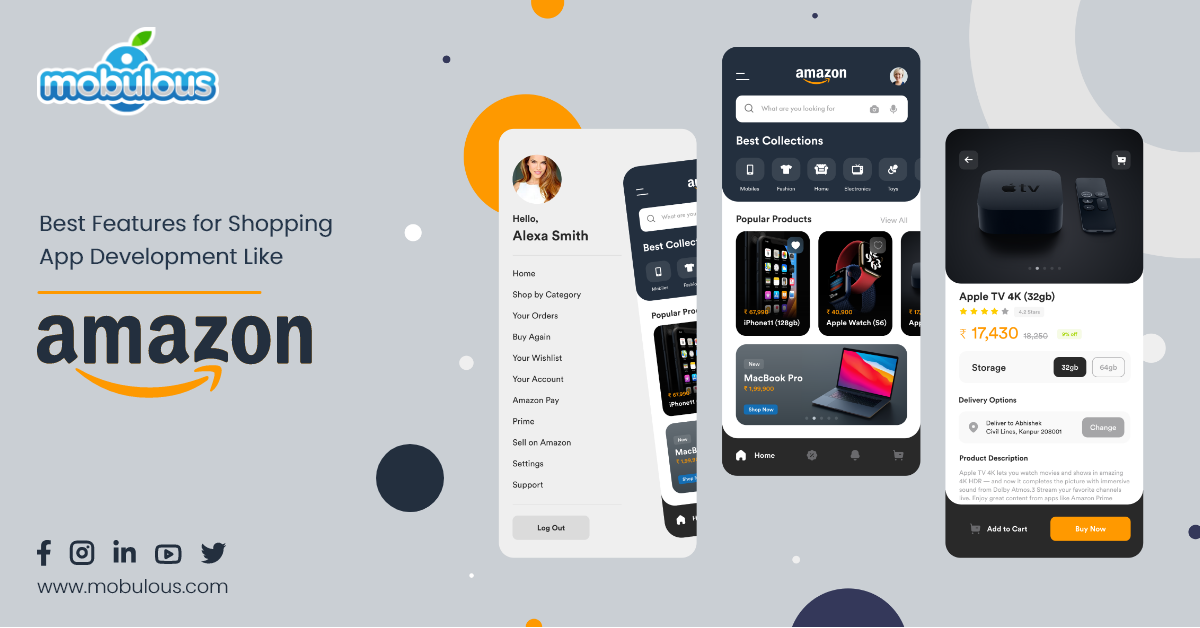
Catalogue, cart, tracking and other features teams usually scope for Amazon-like shopping apps.
Continue Reading
Yes. A mutual NDA is signed before detailed discussion.
Start with free functional and technical discovery under a mutual NDA. Decide catalogue, cart, checkout, fulfilment and whether items are physical or digital for Play billing. Write that into a scope document, then agree a proposal. Design and build, test on low-end Android devices and poor connections, submit to the Play Store, and plan four months free post-launch support as standard in every contract.
Treat it as catalogue, cart, payment classification and order tracking on one backend. On Android, lock Play billing rules for physical versus digital goods during scoping before UI polish. Related work in our delivery record includes fashion retail, multi-store carts, grocery, auctions and B2B marketplaces.
Follow the Android path: classify payment against Play policy, design for low-end cold start, sync cart state across devices, and test checkout under weak networks. Guest versus authenticated checkout and pin-code serviceability belong in the scope document so they are not guessed after launch.
There is no single best answer for every catalogue. Prefer a team that explains Play billing for physical versus digital goods, shows commerce portfolio evidence, signs a mutual NDA, and publishes verified ratings. Mobulous has delivered 700+ apps since 2013, rates 4.7/5 on Clutch (103 reviews) and 4.8/5 on GoodFirms (65+ reviews), and holds ISO/IEC 27001:2022.
Shortlist companies that separate physical and digital payment paths, field-test on low-end Android devices, and document inventory and returns in scope. Compare Clutch, GoodFirms and G2 reviews, IP terms and post-launch support. Mobulous includes four months free post-launch support as standard in every contract.
Mobulous provides Android ecommerce app development services for shopping, marketplace, retail and B2B store models, with discovery focused on Play billing classification and real-device performance. Platform-neutral ecommerce app development is covered on our ecommerce app development company page; this page stays Android-qualified.
Choose on evidence: verified reviews, clear scope before proposal, honest commerce portfolio language and Android-specific payment and performance engineering. Mobulous is a mobile app development company founded in 2013 with 500+ clients, 100+ experts and ISO 9001:2015, ISO/IEC 27001:2022 and CMMI Level 3.
Evaluate on delivery record, payment-policy literacy on each store, and contract terms for IP and support. For Android shopping apps, ask how they classify Play billing before they quote. Mobulous rates 4.7/5 on Clutch (103 reviews), 4.8/5 on GoodFirms (65+ reviews) and 5.0/5 on G2 (5 reviews).
This page covers Android ecommerce and shopping apps, not social networks. Mobulous also builds social products under separate Android social engagements. If your brief mixes social feed features with a store, say so in discovery so catalogue, checkout and feed behaviour are scoped as different modules.
Scope starts with catalogue, cart, checkout and order tracking, then the payment path Play requires for what you sell. Physical goods and offline services use an external payment method. Digital goods and in-app subscriptions use Play billing under current Google policy. Mixed catalogues need separate flows. Exact features are written into the scope document after free discovery.
Yes. Progress updates are part of the engagement after the agreement is signed. Communication channels are written into the agreement so you know how status is shared during build and testing.
Free functional and technical discovery calls with a mutual NDA first. Payment method classification against Play policy during scoping. Catalogue, inventory and existing-system assessment. Scope document, then proposal and agreement. Design and build. Testing on low-end Android devices and poor connections. Play Store submission. Post-launch support: four months free, standard in every contract.
Scope determines cost, and a scope document precedes any proposal. Drivers include catalogue size, payment classification, inventory integrations, marketplace rules and how many platforms share the same backend. Free discovery produces that scope before any proposal.
Ecommerce app development cost follows the same rule: the scope document sets price after you decide store model, payment classification, inventory source and platforms. Free functional and technical discovery calls produce that scope. No fixed public figure is published on this page.
Yes. Play Store submission is part of the engagement flow after build and testing. We prepare the store listing assets with you and handle the upload steps agreed in the scope, including payment classification reflected in the listing.
Commerce products in our delivery record use PHP, React, Node.js, React Native and Flutter. Payment gateways and commerce platforms are client decisions discussed in scoping, not named here as delivered experience unless they appear in the project record.
Talk through Play billing classification, catalogue and inventory before any proposal. 700+ apps delivered, 500+ clients, 12+ years, 4.7/5 on Clutch (103 reviews). Mutual NDA before detailed discussion. ISO/IEC 27001:2022.
Related: Isawitfirst portfolio · Bayin portfolio.
Related reading: app development company, including Android app development, including eCommerce app development, including mobile app development services.