Menus change constantly
Daily specials, sold-out items, and seasonal shifts are normal. Most apps treat the menu as static data. When availability is wrong, guests order what you cannot cook and staff spend the shift apologising.
Mobulous builds apps for restaurants, cafes, recipes, and ordering workflows that match how food businesses actually run. We are a mobile app development company that scopes menus, kitchen capacity, modifiers, and loyalty before the first screen is drawn. Contact us when you are ready to brief the operation, not only the brand look.
Food and beverage businesses have operational problems software rarely solves well. This page is for restaurants, cafes, brands, and producers. Rider dispatch and marketplace logistics belong on food delivery app development. On-demand matching patterns sit under on-demand app development.
Daily specials, sold-out items, and seasonal shifts are normal. Most apps treat the menu as static data. When availability is wrong, guests order what you cannot cook and staff spend the shift apologising.
Taking orders faster than the kitchen can cook them makes the experience worse. Throughput, ticket timing, and prep queues belong in the product design, not only in a manager spreadsheet.
A single burger can have dozens of valid configurations. Getting the data model wrong is expensive later: stock, pricing, allergens, and kitchen tickets all depend on it.
Allergen and dietary information carries legal weight in several markets. It has to live on items, modifiers, and combos, not as a footnote nobody maintains.
One brand often means different menus, prices, and opening hours by site. Location overrides are a first-class requirement, not a phase-two patch.
Point schemes nobody redeems do not retain guests. Rules must be clear at checkout, visible in the app, and workable for staff during a rush.
Use this as a working scope map for restaurant, cafe, and brand apps. Lock the model early so inventory, kitchen tickets, allergens, and pricing stay consistent. Parent delivery logistics stay on food delivery app development when riders and dispatch are the product.
Define the base sellable unit: name, description, media, tax class, and whether it can sell alone. Everything else hangs off this row.
Size, portion, or SKU variants that share a parent but differ in price or prep. Decide if stock is tracked per variant or per parent.
Add-ons, removals, and substitutions with min/max rules. Model required groups separately from optional ones so the kitchen ticket stays unambiguous.
Bundles that pick from sets of items. Price can be fixed or calculated. Combos that ignore sold-outs create refunds and remakes.
Breakfast, lunch, late-night, and day-of-week rules. Sold-out and 86 states must propagate to every channel that shows the menu.
Per-site menus, prices, and hours for multi-location brands. Never assume one catalogue equals one brand.
Attach allergen and dietary flags to items and modifiers. Decide how cross-contact warnings appear before checkout, not after a complaint.
Base price, modifier deltas, happy-hour, and location price lists. Document which rule wins when several apply at once.
Lock the model, then choose build path under mobile app development or compare delivery logistics separately on food delivery app development.
We design and develop custom mobile apps for the food and drink industry, including iOS app development and Android app development, with native and cross-platform options. Features such as ordering flows and menu management are scoped against your kitchen and locations, not a generic template.
Custom apps for restaurants and F&B brands: guest ordering, menu browsing, and account flows tailored to how your sites actually operate.
We build and connect restaurant management tools that bring inventory, ordering, payment processing, and staff workflows into one place for food and drink businesses.
Guest-facing apps for browsing, ordering, and loyalty. When the brief is rider dispatch and marketplace logistics, that work sits under food delivery app development instead of here.
Loyalty modules for retention: points, referral rules, and offers that redeem cleanly at checkout without slowing a busy service.
Apps for cloud kitchens and digital-only brands: menu management, online ordering, multi-channel presentation, and operational reporting.
Integrations with payment gateways, maps, review platforms, and other systems your stack already uses. We treat each vendor as a scope item with its own availability and error behaviour.
App types we commonly scope: restaurant ordering, recipe and cooking guides, grocery catalogues, coffee ordering, nutrition tracking, and dining reservations. Delivery marketplace builds stay on food delivery app development.
Our reading of what is changing in food and beverage product work. Positions, not adoption statistics.
Zomato, Swiggy, and Uber Eats take a large cut. That is why brands invest in their own app: to own the guest relationship and reduce commission dependence. Say so plainly in the brief. Our view: an own-app only pays off if menu accuracy, loyalty, and repeat ordering are better than the aggregator experience, not merely cheaper to list.
QR menus are no longer novel. Guests expect them to work, update in real time, and hand tickets to the kitchen without staff retyping. Our view: treat QR as a channel into the same menu model, not a separate brochure site that drifts out of date.
Screens that show fire order, modifiers, and course timing beat paper when volume rises. Our view: budget for the kitchen queue and station routing as product work. Without it, faster guest ordering only floods the pass.
Recommendations help when history is rich and stock is reliable. They fail when they push sold-out items, ignore allergens, or invent preferences from thin data. Our view: start with honest availability and search; add personalisation only where you can prove it does not create remakes.
Stack choices below match platforms and frameworks we have shipped on F&B projects in our portfolio records. Payment gateways and aggregator APIs differ by market. We write them as options a client chooses between, not as a claim that every engagement used the same vendor.
React Native, Kotlin, Swift, Angular, React.js, HTML/CSS/PHP where the product is web-first. Cross-platform and native are chosen by device needs and store targets.
Node.js appears across restaurant and coffee projects we have shipped. APIs carry menu, order state, and staff roles. Aggregator APIs differ on how they handle item availability; plan for that when a brand still lists on marketplaces.
Clients typically choose among gateways such as Razorpay, Stripe, PayPal, or Square based on market and settlement needs. Our F&B portfolio records show payment handling (including cashless checkout and regional gateways) without naming those four as a fixed delivered stack. POS and aggregator links are scoped when the brief requires them.
Store locators, order status, and push alerts are common on guest apps. Map providers and notification services are selected per project; we do not list a single vendor as universal experience.
Four F&B and grocery projects from our portfolio records. Descriptions focus on restaurant, brand, and catalogue mechanics. Rider-marketplace framing belongs on the food delivery page.
Client: Harako Tech. Restaurant management with QR ordering for guests, kitchen and wait staff onboarding, and a single panel for menus, orders, and daily reports. Built so the floor and the pass share one order state.
Client: Burger King. Guest product built around menu and nutritional information, restaurant locator, customised orders, order-ahead and pickup, promotions, and loyalty. Framed here by brand F&B mechanics, not marketplace logistics.
Client: Madanlal Pansari. Trusted online destination for daily grocery needs: kirana items, dry fruits, pulses, spices, and cosmetics, delivered to the doorstep. Everyday essentials through premium dry fruits, nutritious pulses, aromatic spices, and personal care under one roof.
Client: FoodKarma LLC. Marketplace where buyers browsed F&B catalogue listings, filtered and searched products, opened product detail, placed orders, tracked fulfilment, and paid through an integrated payment gateway on a React Native codebase for iOS and Android. Consumer apps are no longer operating; company presence remains on the web and LinkedIn.
Mobulous follows a structured approach to food and drink apps so menu rules, kitchen flows, and guest journeys stay aligned. Stages below; duration depends on scope and feedback speed, not a fixed calendar promise.
We start with market and competitor context, audience needs, and stakeholder workshops to document scope, menu model decisions, and the food and drink roadmap.
Wireframes and prototypes focused on ordering flow, kitchen and staff views where needed, and clear allergen and modifier presentation.
Choose frameworks and integrations for menu data, order state, inventory hooks, and payment processing that match the locations you operate.
Agile delivery with regular demos. Build guest and staff surfaces, connect restaurant systems where required, and keep payment and order paths secure.
Device and flow testing for ordering, sold-out handling, multi-location menus, and security checks before release.
Store submission or web launch, then maintenance, updates, and operational fixes so the app stays usable through menu and seasonal change.
Since 2013 we have delivered 700+ apps for 500+ clients across 30+ countries, with 100+ experts and offices in Noida, Newark (Delaware), and Calgary (Alberta). We rate 4.7/5 on Clutch across 103 reviews. Certifications: ISO 9001:2015, ISO/IEC 27001:2022, CMMI Level 3.
Experience since 2013 on mobile and web products, including food and beverage builds with menu, ordering, and staff workflows.
We align features to your locations, kitchen process, and loyalty rules rather than forcing a single industry template.
Encryption, authentication, and payment handling are part of build practice. ISO/IEC 27001:2022 sits alongside our delivery process.
Repositories, store listings, and cloud accounts sit in your name. An NDA is available before detailed technical discussion.
Reading on food and restaurant builds
How a restaurant operations product handles menus, orders, and staff workflows online.
Continue Reading

Notes from the Burger King Nigeria digital product work for menu-led guest experiences.
Continue Reading
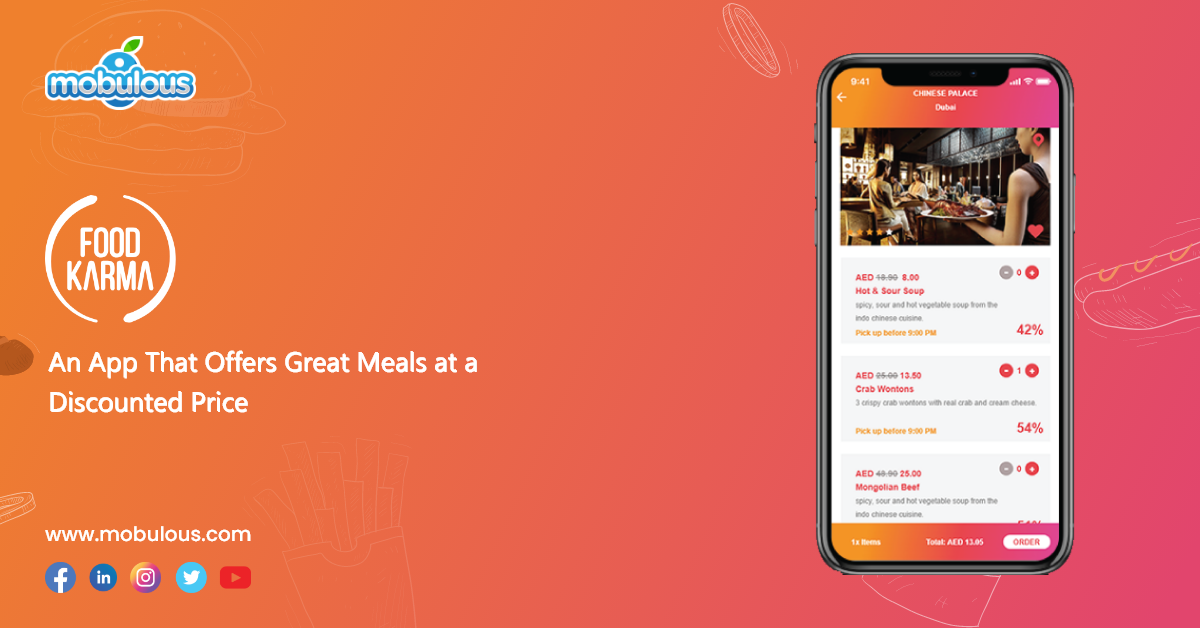
An F&B surplus and ordering product that connects kitchens with guests seeking discounted meals.
Continue Reading
"They were always available to solve all our queries and doubts regarding the grocery app."
Verified on Clutch →"They were highly receptive to feedback and agile in addressing the project's evolving needs."
Verified on Clutch →"It was easy and comfortable to communicate with their project manager."
Verified on Clutch →Mobulous rates 4.7/5 on Clutch across 103 reviews. View the full Clutch profile →
Food and drink applications are digital platforms that allow users to order food, explore recipes, make reservations, or track grocery deliveries. They improve convenience and efficiency for customers and simplify operations for food businesses.
In order to start a food app, you need to follow the below steps carefully: Research the target audience and understand their needs efficiently. Define app features and plan the functionalities clearly. Select the technology stack, platforms, and frameworks effectively. Hire a food and drink app development team by collaborating with experts. Launch and promote the app by marketing the application effectively.
Technology is transforming the food and beverage industry through automation, real-time delivery tracking, AI-powered recommendations, digital payments, and inventory management systems that enhance customer experiences, profitability, and operational efficiency for businesses.
Cost depends on menu complexity, multi-location rules, kitchen and staff workflows, payment handling, and whether you need a customer app, staff tools, or both. Platforms, integrations, and post-launch support also move the number. We scope fixed-price against a written brief rather than publishing a generic range. See our app development pricing model for how we break drivers down, then book a scoping call for a quote against your menu and operations.
Food and drink app development technology encompasses digital tools, systems, and applications that optimize production, ordering, delivery, and inventory, allowing for efficiency, innovation, and enhanced customer experiences in the food and beverages industry.
Food and drink applications are generally built for iOS, Android, and web app platforms, ensuring accessibility and seamless user experiences across diverse devices for broader customer reach and engagement.
Food and drink app development is the methodology of building specialized mobile apps that cater to diverse prospects of the food and drink industry. These mobile apps serve multiple purposes, from food ordering and delivery to recipe sharing and restaurant management. These apps blend advanced technologies and frameworks with user-centric interfaces to simplify food-related features like online ordering, payment processing, customer engagement tools, and delivery tracking options.
Food and beverage applications serve as digital bridges between customers and food service providers, streamlining the procedure of discovering, ordering, and enjoying culinary experiences. These platforms enrich convenience, simplify operations for businesses, provide personalized recommendations, and create seamless interactions throughout the food service ecosystem.
The food and drink app requires back-end infrastructure, real-time tracking capabilities, secure payment gateways, and scalable database management systems. Crucial elements include cross-platform app development compatibility, high-performance servers, effective API integrations, comprehensive security protocols, and reliable hosting solutions in order to ensure smooth and seamless operations.
The food and drink apps cater to different user groups seeking convenient, engaging, and effective ways to interact with food-related services. Primary audiences include busy urban professionals, health-conscious food enthusiasts, students and young adults, restaurant business owners, home-based food entrepreneurs, and regular food delivery users.
The food and drink app connects users, restaurants, and delivery partners through an integrated platform. Users browse menus, place orders, and track deliveries in real time. Restaurants receive orders, handle inventory, and process fulfillment of the orders. The system manages payments, maintains communication between all parties, and coordinates deliveries.
Food and beverage platforms typically integrate secure payment options such as credit/debit cards, UPI transactions, digital wallets (Google Pay and Apple Pay), and cash on delivery, plus saved methods, loyalty redemption, and refunds where needed. Security practice includes encryption for data in transit and at rest, strong authentication, payment gateway controls, and regular updates and backups to protect accounts and transactions.
Mobulous is a food and drink app development company for restaurants, cafes, and F&B brands that need ordering, kitchen, and loyalty workflows that match operations. We have delivered 700+ apps since 2013 from Noida (with offices in Newark, Delaware, and Calgary, Alberta), and rate 4.7/5 on Clutch (103 reviews). NDA available before detailed technical discussion.
Compare delivery logistics on food delivery app development, on-demand matching on on-demand app development, or the parent offer on mobile app development. Cost drivers: app development pricing model.
Related reading: mobile application development company, including food delivery app development, including mobile app development services.