















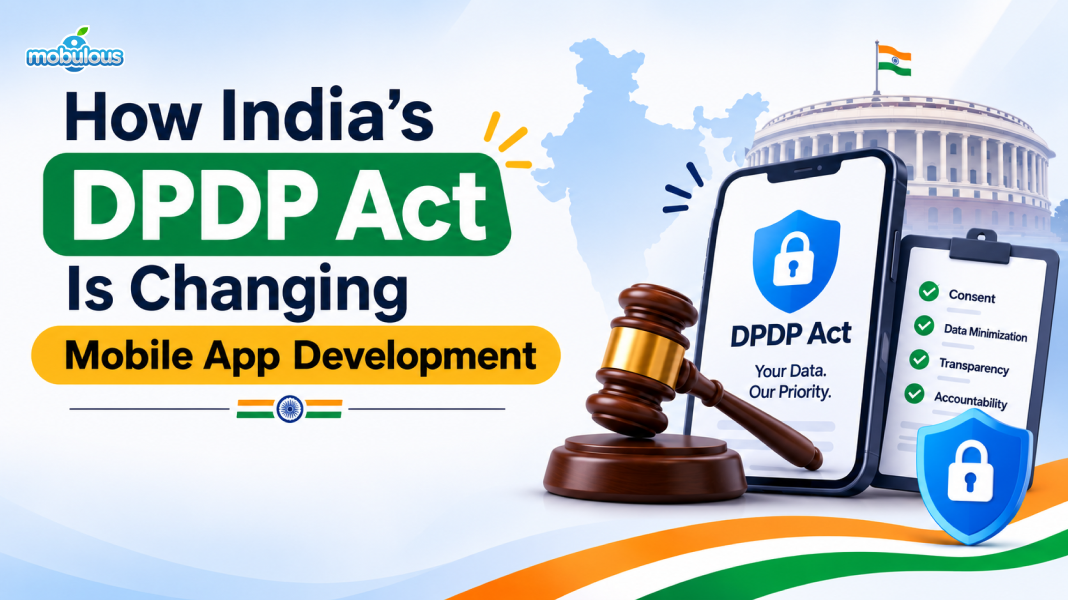
Every sign-up, ride booking, and payment hands an app someone’s personal data. As India’s DPDP framework phases in, privacy cannot wait until after launch. DPDP Act compliance for mobile apps now shapes how products are planned, built, and maintained. Here is what that means.
What Is India’s Digital Personal Data Protection (DPDP) Act, 2023 & Why Does It Matter for Mobile Apps?
The Digital Personal Data Protection Act, 2023 is India’s first dedicated data protection law. It governs how organizations collect, use, store, and share digital personal data, and it applies to mobile apps that process the data of people in India. Its impact on app development is substantial.
Why the Law Was Introduced
The Act received Presidential assent on 11 August 2023, years after the Supreme Court recognised privacy as a fundamental right in 2017. It gives individuals more control over their data and holds organizations accountable for how they handle it.
What Counts as Digital Personal Data
Personal data is any data about an individual who is identifiable by or in relation to that data. In apps, that includes names, phone numbers, emails, location, payment details, profile information and behavioural history. Device identifiers and contact lists can qualify when they relate to an identifiable person. The Act has no separate “sensitive data” category, so a health record and a newsletter email fall under the same law, although sector regulators may add stricter rules.
DPDP Rules 2025 for Mobile App Developers: What Applies and When
The DPDP Act’s impact on app development arrives in stages. The Act’s commencement was notified through G.S.R. 843(E), and the DPDP Rules, 2025 through G.S.R. 846(E), both on 13 November 2025, with phased commencement.
|
Date |
What takes effect |
Relevance for app owners |
|
13 November 2025 |
Rules 1, 2 and 17 to 21, plus Act provisions on definitions and the Data Protection Board |
Institutional groundwork; no new app-level duties |
|
13 November 2026 |
Section 6(9) and Rule 4: Consent Manager registration |
Registration opened this month; relevant only if you plan to apply as a Consent Manager |
|
13 May 2027 |
Remaining provisions, including notice, consent, security safeguards, breach reporting, retention, children’s data, user rights and penalties (Rules 3, 5 to 16, 22 and 23) |
The main obligations for app owners |
What Are the Key DPDP Act Compliance Requirements for Mobile Apps?
Several DPDP Act requirements for mobile apps are legal duties of the Data Fiduciary, while many engineering practices simply help meet them. Knowing the difference keeps projects focused. The duties below apply from 13 May 2027, when most substantive provisions commence.
1. Lawful Processing of Personal Data
Personal data may be processed only for a lawful purpose, either with the user’s consent or under a legitimate use, such as compliance with a law or a medical emergency.
2. Notice and Transparency
When asking for consent, the app must give a clear, itemized notice covering what data is collected, why, how to withdraw consent, exercise rights, and complain to the Board.
3. Purpose Limitation
Data collected for a stated purpose should be used only for that purpose. New uses, such as marketing, need fresh consent or another lawful basis.
4. Reasonable Security Safeguards
Section 8(5) requires reasonable safeguards to prevent breaches. Rule 6 sets a minimum floor, including encryption, masking or tokenization, access controls, logging, backups, and security terms in processor contracts.
5. Data Retention and Erasure
Data must be erased once its purpose is served or consent is withdrawn, unless a law requires retention. Rule 8 adds inactivity timelines for certain large platforms.
How Should Mobile Apps Implement DPDP-Compliant User Consent Management?
User consent management in mobile apps should be designed before the first screen is built, not added later. Android and iOS permission pop-ups control device access, whereas DPDP consent concerns why personal data is processed. One does not automatically replace the other.
1. Clear and Understandable Privacy Notices
Present a standalone notice in plain language. Users must be able to access the consent request in English or any language listed in the Eighth Schedule of the Constitution.
2. Purpose-Specific Consent Collection
Avoid bundled consent. Ask separately for each purpose, such as account creation, marketing messages, and analytics, so users can agree to some uses and decline others.
3. Consent Withdrawal Mechanism
Withdrawal must be as easy as giving consent. Add a visible in-app control, such as a privacy settings screen, and stop processing within a reasonable time.
4. Recording & Maintaining Consent Records
The fiduciary must be able to prove that notice was given and consent obtained. Store timestamped records linking user, notice version, purposes, and any withdrawal, with restricted access.
5. Handling Permissions
Request location, camera, microphone, contacts, and similar access only when a feature needs it, with a clear in-context explanation. An OS grant does not by itself amount to DPDP consent.
How Does the DPDP Act Affect User Data Storage, Processing, & Sharing?
Mobile app data protection in India now reaches backend architecture, databases, and APIs, not just the user interface. The DPDP Act does not impose a blanket requirement to store all personal data in India, though cross-border transfers can be restricted by government notification.
1. Data Minimization & Purpose Limitation
Collect only the data a feature needs. The Act limits consent to data necessary for the stated purpose, so audit every form field, API payload, and analytics event.
2. Secure Database Architecture
Separate identity data from activity data, encrypt sensitive fields, and use tokenization where possible. Rule 6 names encryption, masking, and virtual tokens among minimum safeguards.
3. Role-Based Access Controls
Limit who can view personal data using least-privilege roles, multi-factor authentication for admin panels, and access logs. Rule 6 expects access controls and monitoring of who accesses personal data.
4. Data Retention Policies
Set retention periods. Rule 8 requires certain large platforms to erase data after three years of inactivity, with 48 hours’ notice, and sets a one-year minimum for logs.
The inactivity rule applies to specified classes, namely e-commerce entities and social media intermediaries with two crore or more registered users, and online gaming intermediaries with fifty lakh or more. Check whether your app falls within them.
5. Data Sharing with Business Partners
Share data only for purposes disclosed in the notice, and document each recipient. Fiduciaries remain responsible for personal data processed on their behalf, including by processors.
How Does DPDP Act Compliance Affect Third-Party SDKs, APIs, & Cloud Integrations?
Most apps rely on external services for analytics, notifications, maps, payments, and hosting, and each integration can receive personal data. Under the DPDP Act, the app owner stays accountable, so developers should audit every SDK before integrating it and again at each update.
1. Third-Party Analytics SDKs
Analytics tools can collect device identifiers, IP addresses, and behavioural events. Initialize them only after consent where personal data is involved, and configure collection to the minimum required.
2. Push Notification Services
Services such as Firebase Cloud Messaging use device tokens tied to users. Treat tokens as personal data, collect marketing opt-ins separately, and delete tokens when users withdraw or leave.
3. Mapping & Location APIs
Maps, geocoding, and routing APIs often receive precise coordinates. Request the coarsest location that meets the feature, avoid background tracking unless essential, and limit how long location history is stored.
4. Data Processors & Vendor Relationships
Cloud hosts, analytics vendors, and developers handling data for you are typically Data Processors. Maintain a vendor register covering data types, purposes, locations, and sub-processors.
5. Data Processing Agreements & Contractual Safeguards
A processor may be engaged only under a valid contract. Cover purpose limits, security measures, breach cooperation, deletion, and sub-processor controls in writing.
Firebase, AWS, and Google Cloud offer security controls, regional hosting options, and data processing terms. Using any of them does not make an app DPDP-compliant. Configuration, consent logic, data flows, and contracts remain the app owner’s responsibility.
What Are the DPDP Act Requirements for Children’s Data in Mobile Applications?
Children’s data receives special protection under the Act. Age verification establishes whether a user is a child, while verifiable parental consent confirms that an identifiable parent or lawful guardian has approved processing. They are separate steps, and apps that may serve minors need both considered early.
1. Statutory Definition of a Child Under the DPDP Act
Under Section 2(f), a child is anyone below 18 years. This is higher than the age used in many other jurisdictions, so teen-focused apps are within scope.
2. Verifiable Parental Consent Requirements
Before processing a child’s data, the app owner must obtain verifiable consent from a parent or lawful guardian. Rule 10 requires measures to verify that the person is an identifiable adult.
3. Restrictions on Tracking & Behavioural Monitoring
Section 9 bars tracking, behavioural monitoring and targeted advertising directed at children, subject to prescribed exemptions. Review analytics, recommendation and ad SDKs in any app used by minors.
4. Applicable Exemptions and Their Conditions
Rule 12 and the Fourth Schedule exempt specified classes, such as clinical establishments, educational institutions and childcare providers, and certain purposes, but only within strict conditions. Check applicability carefully.
For instance, an educational institution’s exemption is limited to tracking or behavioural monitoring for educational activities or the safety of enrolled children. It is not a general permission for profiling or advertising. Whether a particular EdTech, healthcare, or childcare app falls within a listed class is a legal question to settle with counsel.
5. Privacy-Conscious Onboarding for Children’s Apps
Ask for as little as possible at sign-up, use age screening, route parents through a verification step, and keep tracking SDKs, ads, and profiling switched off for child accounts.
- Rule 10 contemplates verifying a parent using reliable identity and age details the fiduciary already holds, details the parent voluntarily provides, or a virtual token issued by an authorised entity, such as a Digital Locker service provider.
- Rule 11 separately addresses lawful guardians of certain persons with disabilities.
How Can Businesses Make Existing Mobile Apps DPDP Compliant?
This DPDP compliance checklist for app developers gives owners of existing Android and iOS apps a practical roadmap. With most obligations commencing on 13 May 2027, there is time to prepare, but compliance is an ongoing process, not a one-time development task.
|
Step |
What to do |
Typical output |
|
Conduct a Personal Data Audit |
Map every data point across screens, APIs, databases, logs, backups, and SDKs, with its purpose, location, and recipients |
Data inventory and data-flow map |
|
Review Privacy Notices & Consent Mechanisms |
Rewrite notices to itemize data and purposes; replace bundled consent with purpose-specific, withdrawable consent |
Updated notice, consent screens, consent log |
|
Audit Third-Party SDKs and API Integrations |
Identify what each SDK collects, gate it behind consent, remove unnecessary ones, and review contracts |
SDK register and vendor agreements |
|
Establish Data Retention and Deletion Workflows |
Define retention per data category; automate deletion across backups and analytics; apply Rule 8 timelines where relevant |
Retention schedule and deletion jobs |
|
Implement Grievance & User-Rights Management Processes |
Provide in-app channels for access, correction, erasure and complaints; publish contact details; prepare a breach response runbook |
Rights-request workflow and incident playbook |
How Can a Mobile App Development Company Help Businesses Achieve DPDP Compliance?
Compliance involves legal interpretation, which belongs with qualified counsel, but many obligations become engineering tasks. An experienced mobile app development company can build privacy considerations into every stage of the app lifecycle, from discovery and design through testing, release, and post-launch maintenance.
1. Privacy-Focused App Architecture
A capable partner maps data flows, minimizes collected fields, separates identity data, and designs retention and deletion into the system from the start, rather than retrofitting them later.
2. Secure Android & iOS App Development
Native and cross-platform builds should use secure local storage such as Keychain and Keystore, certificate pinning where appropriate, careful logging, and permission requests tied to actual features.
3. Consent Management Integration
Consent screens, preference centers, withdrawal controls, and consent logs can be built into the app and backend, so SDKs and features respect each user’s choices.
4. Secure API & Backend Development
Backend work includes authenticated, least-privilege APIs, encryption in transit and at rest, audit logging, rate limiting, and deletion endpoints that propagate erasure across databases, caches, and connected services.
5. Third-Party SDK & API Audits
Before integration and during maintenance, each SDK is reviewed for data collected, permissions requested, hosting, retention, and contracts, then configured to run only when consent and purpose allow.
If you are planning a new app, or reviewing an existing one, speak with the Mobulous team about building a secure, scalable and privacy-focused mobile application. Share your app’s data flows and integrations, and Mobulous can help translate your legal team’s guidance on DPDP Act compliance for mobile apps into concrete technical work.
Frequently Asked Questions About DPDP Act Compliance for Mobile Apps
Q1. What is the DPDP Act, 2023, in simple terms?
Ans. It is India’s law on digital personal data. It requires organizations to process personal data lawfully, give clear notice, respect user rights, keep data secure, and report breaches. Individuals, called Data Principals, gain rights, while organizations deciding why data is processed, called Data Fiduciaries, carry the duties.
Q2. Does the DPDP Act apply to all mobile applications in India?
Ans. It applies to apps that process digital personal data within India, and to some outside India that offer goods or services to people in India. Exemptions and specific provisions exist, so applicability depends on the activity and the organization’s role.
Q3. Is user consent mandatory for collecting personal data in mobile apps?
Ans. Not always. Consent is the main lawful basis, but the Act also allows processing for listed legitimate uses, such as legal obligations or medical emergencies. Where consent is relied on, it must be free, specific, informed, unconditional, and unambiguous, with a clear affirmative action and an easy withdrawal option.
Q4. Does the DPDP Act require mobile app data to be stored in India?
Ans. The Act sets no blanket localization requirement. Transfers outside India are permitted except to countries restricted by government notification, and Significant Data Fiduciaries may face limits on specified data. Sector regulators, such as the RBI for payments data, can impose separate rules.
Q5. What happens if a mobile app fails to comply with the DPDP Act?
Ans. The Data Protection Board can impose monetary penalties once penalty provisions commence on 13 May 2027. The Act’s schedule caps penalties at ₹250 crore for security safeguard failures and ₹200 crore for breach notification or children’s data failures. Actual amounts depend on the Board’s findings.
Q6. What are the DPDP Act requirements for children’s mobile applications?
Ans. Data Fiduciaries must obtain verifiable parental or guardian consent before processing a child’s (under 18) personal data, and must not track, behaviourally monitor, or target ads at children, subject to limited exemptions in Rule 12 and the Fourth Schedule. Requirements commence on 13 May 2027.
Q7. How can businesses make their existing mobile apps DPDP-compliant?
Ans. Start with a personal data audit, then update notices and consent flows, audit SDKs, set retention and deletion workflows, and build user-rights and grievance processes. Treat it as ongoing work, reviewed whenever features, vendors, or data practices change. Involve legal counsel.
Q8. Does the DPDP Act apply to third-party SDKs and APIs?
Ans. The Act does not mention SDKs specifically, but the app owner, as a Data Fiduciary, remains responsible for personal data processed on its behalf, including by processors. SDK data flows therefore need auditing, disclosure in the notice and, for processors, written contracts.
Q9. How can a mobile app development company help with DPDP compliance?
Ans. A development company can map data flows, build consent and withdrawal features, apply security safeguards, audit SDKs, implement retention and deletion logic, and support rights-request workflows from design through post-launch maintenance. Legal interpretation and formal compliance assessments still require qualified legal advisers.
Q10. Is ISO 27001 certification sufficient for DPDP compliance?
Ans. No. ISO/IEC 27001 certifies an information security management system, which supports the security safeguards duty. DPDP compliance also covers notice, consent, purpose limitation, retention, user rights, children’s data, and breach reporting, so certification alone cannot establish compliance. Use it as a foundation, not proof.