















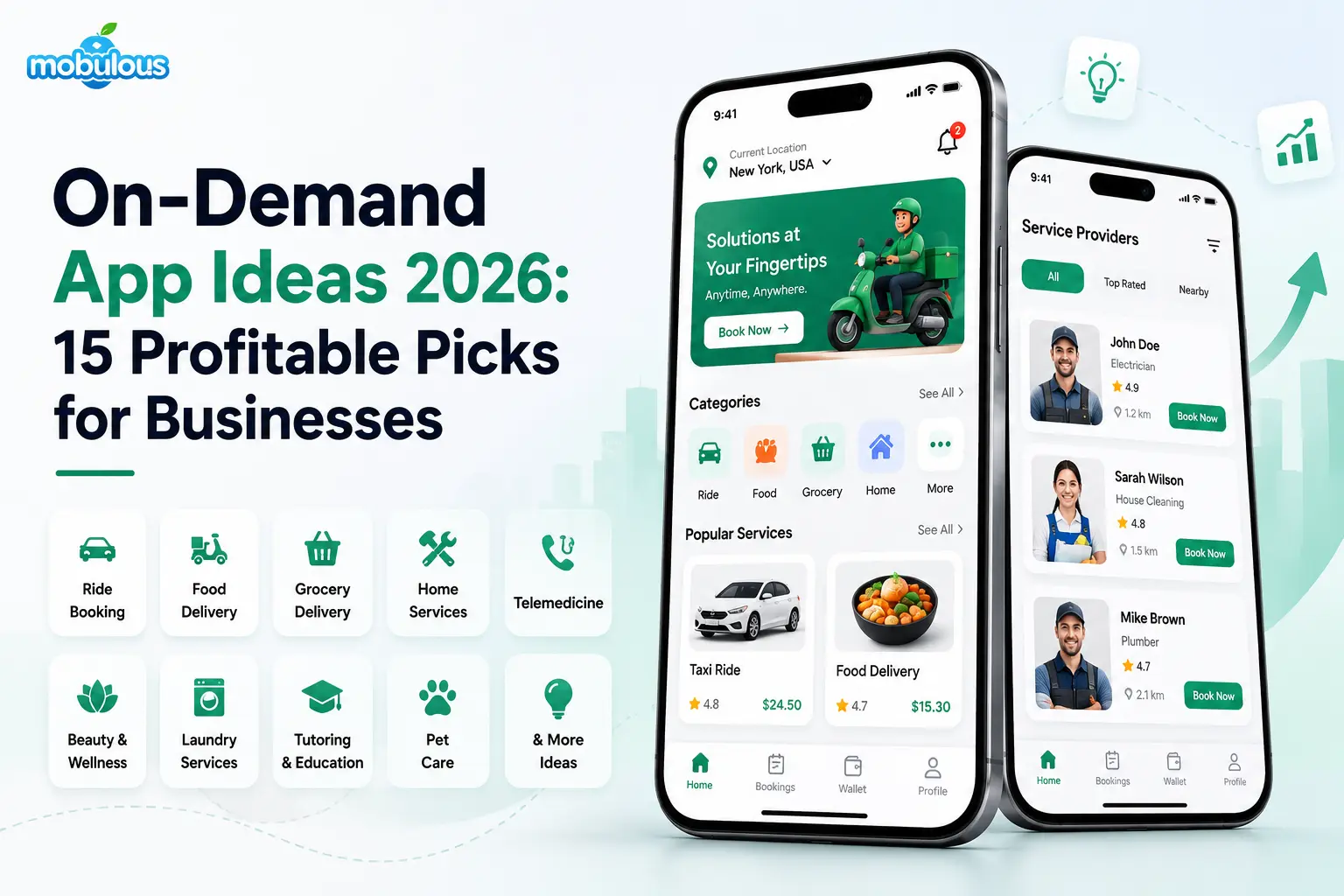
On-demand apps connect customers with services in minutes, and expectations keep rising. In 2026, the best on-demand app ideas solve a real problem, earn recurring revenue, and scale. This guide compares 15 options, revenue models, costs, and AI, with insights from Mobulous, a mobile app development company. Let’s begin.
15 Most Profitable On-Demand App Ideas to Launch in 2026
Each idea below includes a quick overview, audience, core features, profit potential, and a real-world example. None is guaranteed to earn money. Results depend on your market, pricing, and execution, so treat these profitable on-demand app ideas as starting points for validation, not promises.
1. On-Demand Grocery Delivery App
A grocery delivery app lets shoppers order from local supermarkets or dark stores and receive items within hours or minutes. It solves the time cost of weekly shopping, while giving retailers a digital storefront, delivery logistics, and repeat-order tools without building every system from scratch.
Target Audience: Busy households, working professionals, older adults, and supermarket or convenience chains moving online.
Key Features:
- Real-time inventory sync so customers only see what is in stock.
- Slot-based or instant delivery scheduling with live GPS order tracking.
- Substitution preferences and saved reorder lists for repeat baskets.
Profit Potential: Grocery is a frequent, habitual purchase, which supports retention. Published estimates for the 2025 online grocery market range from about $655 billion to $906 billion, because research firms define the category differently. The catch is thin margins. Inventory accuracy, delivery cost, and customer acquisition against entrenched rivals decide who profits. Niches such as organic, ethnic, or restaurant supply can defend margins.
2. On-Demand Healthcare and Doctor Consultation App
A doctor consultation app connects patients with licensed clinicians through video, audio, or chat, with booking, e-prescriptions, and records in one place. It solves long clinic waits and limited specialist access, while helping providers extend their reach beyond physical locations.
Target Audience: Patients with routine or chronic needs, remote communities, clinics, hospital groups, corporate wellness programs, and insurers.
Key Features:
- Encrypted video consultations built to meet HIPAA, GDPR, or local health-data rules.
- Appointment scheduling with clinician availability, reminders, and e-prescriptions.
- Health records, lab report uploads, and AI-assisted symptom intake reviewed by clinicians.
Profit Potential: Grand View Research values the global telehealth market at $77.4 billion in 2025, with $87.7 billion projected for 2026 and $187.5 billion by 2033. Revenue can come from consultation commissions, clinic subscriptions, and employer plans. Barriers are heavy: licensing, data privacy, malpractice exposure, and clinician supply. Compliance planning has to come before feature building.
3. On-Demand Home Services App
A home services app matches customers with vetted plumbers, electricians, cleaners, and technicians for same-day or scheduled jobs. It solves the uncertainty of finding reliable professionals and comparing prices, while giving independent providers a steady stream of local jobs without heavy marketing spend.
Target Audience: Homeowners, renters, property managers, real estate agencies, and independent tradespeople or service companies.
Key Features:
- Provider verification with background checks, ratings, and portfolio profiles.
- Upfront pricing or quote requests with in-app chat and job scheduling.
- Secure payments released after job completion, with a dispute resolution flow.
Profit Potential: Cleaning and maintenance create repeat bookings, and commissions rise with job value. The tough part is leakage, where customers and providers take repeat jobs off the platform. Winning apps add guarantees, insurance, and scheduling tools that make staying worthwhile. Launching in one city with two or three categories keeps quality manageable.
4. On-Demand Food Delivery App
A food delivery app lets diners browse restaurant menus, order, pay, and track riders in real time. It solves hunger-time friction for customers and gives restaurants a delivery channel, order management tools, and reach beyond their neighborhood without building their own fleet.
Target Audience: Urban diners, office workers, students, restaurants, cloud kitchens, and regional chains wanting a branded ordering channel.
Key Features:
- Multi-restaurant menus with customizable orders, offers, and ratings.
- Live rider tracking with automated dispatch and delivery time estimates.
- Multiple payment options, tips, wallet credits, and loyalty rewards.
Profit Potential: Order frequency is high, but this is the most crowded of the on-demand delivery app ideas on this list. Even at DoorDash’s scale, Q4 2025 revenue was about 13 percent of marketplace order value, and gross profit about 6 percent, which shows how thin delivery margins can be. New entrants do better with a focus: one city, one cuisine, a campus, or white-label ordering for restaurant groups.
5. On-Demand Beauty and Salon Services App
A beauty services app lets customers book stylists, makeup artists, and spa therapists at a salon or at home. It solves scheduling hassles and uncertain quality, while helping independent professionals fill empty slots, collect deposits, and build a repeat client base through reviews and portfolios.
Target Audience: Working professionals, event clients, busy parents, salon owners, freelance stylists, and wellness studios.
Key Features:
- Service menus with stylist portfolios, reviews, and calendar-based booking.
- Deposit and no-show protection through in-app payments and cancellation rules.
- Rebooking reminders and personalized offers based on appointment history.
Profit Potential: Beauty is a habitual spend, so rebooking every few weeks supports retention. Revenue can include commissions, booking fees, professional subscriptions, and product sales. The main risk is disintermediation, as stylists may move clients to direct bookings. Calendars, payments, and marketing tools give them a reason to stay on the platform.
6. On-Demand Car Wash and Auto Repair App
A car care app lets drivers schedule mobile car washes, detailing, servicing, and roadside repairs at home or the office. It solves lost time at garages and unclear pricing, while giving technicians route-optimized schedules, upfront quotes, and digital service records for each vehicle.
Target Audience: Urban car owners, fleet operators, ride-hailing drivers, car rental firms, residential complexes, and independent garages.
Key Features:
- Location-based booking with technician availability and live arrival tracking.
- Itemized quotes, vehicle service history, and maintenance reminders.
- Fleet dashboards with subscription packages and consolidated billing.
Profit Potential: Vehicles need recurring maintenance, and wash subscriptions or fleet contracts add predictable revenue. Margins depend on utilization. Technician travel time, equipment costs, and local rules on mobile washing can erode profit. Starting in a dense service zone or with B2B fleets improves unit economics.
7. On-Demand Logistics and Courier Delivery App
A courier app connects senders with nearby drivers for same-day parcels, documents, and goods. It solves unreliable local delivery and slow booking through instant quotes, live tracking, and proof of delivery, while giving drivers flexible work and businesses a scalable delivery option.
Target Audience: Small and mid-sized businesses, e-commerce sellers, florists, pharmacies, individuals sending parcels, and independent drivers.
Key Features:
- Instant fare estimates based on distance, vehicle type, and urgency.
- Live GPS tracking, route optimization, and proof of delivery by photo or OTP.
- Business accounts with API access, bulk bookings, and invoicing.
Profit Potential: Global Market Insights projected on-demand logistics growing from $16.3 billion in 2023 to $80.3 billion by 2032, a 2024 forecast worth rechecking before you plan around it. B2B accounts bring recurring volume. Challenges include balancing driver supply with demand, insurance, and fuel costs. Partner drivers reduce upfront spend, though service quality depends on onboarding.
8. On-Demand Laundry and Dry Cleaning App
A laundry app schedules pickup, cleaning, and doorstep return of clothes, linens, and dry cleaning. It solves the time burden of laundromat visits and inconsistent turnaround, giving customers transparent pricing and status updates while helping laundries fill capacity with predictable pickup routes.
Target Audience: Busy professionals, students, hotels and short-term rental hosts, gyms, restaurants, and local laundry operators.
Key Features:
- Pickup and delivery slot booking with garment-level order tracking.
- Item-based pricing, special care notes, and photo records of garment condition.
- Subscription plans and wallet credits for weekly or monthly laundry.
Profit Potential: Laundry is a recurring need, so subscriptions and business accounts for hotels and rentals can stabilize revenue. The model is operations-heavy, because processing capacity, damage claims, and driver routes all affect margins. Partnering with existing laundries lowers startup cost, while owning a facility improves quality control.
9. On-Demand Pet Care and Grooming App
A pet care app connects owners with groomers, walkers, sitters, and veterinary services through verified profiles and in-app booking. It solves the worry of finding trustworthy care while owners work or travel, and gives pet professionals a steady client pipeline with scheduling, payments, and photo updates.
Target Audience: Urban pet owners, frequent travelers, working professionals, independent groomers and walkers, boarding facilities, and veterinary clinics.
Key Features:
- Verified provider profiles with reviews, insurance details, and pet preferences.
- Booking for walks, grooming, and sitting with GPS walk tracking and photo updates.
- Pet health profiles with vaccination records and reminder alerts.
Profit Potential: Owners tend to spend consistently on their pets, and recurring walks, grooming, and boarding drive repeat use. Trust is the competitive edge, which adds verification and insurance costs. Holiday spikes can strain supply, and demand is hyperlocal, so city-by-city expansion usually works better than a wide launch.
10. On-Demand Fitness and Personal Training App
A fitness app lets users book trainers, join live or recorded classes, and follow personalized plans from their phones. It solves the cost, scheduling, and motivation barriers of traditional gyms, while giving trainers and studios a platform to monetize their expertise beyond local clients.
Target Audience: Busy professionals, beginners, people recovering from injury, corporate wellness teams, independent trainers, and boutique studios.
Key Features:
- Trainer discovery with live video sessions, in-person booking, and class scheduling.
- Personalized workout and nutrition plans using AI and wearable integrations.
- Progress tracking, challenges, and community features to improve retention.
Profit Potential: Subscriptions and session bookings provide predictable revenue, and corporate wellness deals add volume. Retention is the main challenge, since many users drop off within weeks. Serving a niche such as postpartum recovery, seniors, or athletes, with strong engagement features, matters more than adding another generic workout library.
11. On-Demand Tutoring and Online Education App
A tutoring app matches students with qualified tutors for live lessons, homework help, and exam preparation. It solves the difficulty of finding subject experts at convenient times and prices, while giving educators a way to teach beyond their location and manage bookings, payments, and materials.
Target Audience: School and college students, parents, adult learners, test-prep candidates, independent tutors, coaching centers, and schools.
Key Features:
- Tutor search by subject, level, availability, and price, with trial lessons.
- Virtual classroom with video, whiteboard, screen sharing, and session recording.
- Progress reports, assignments, and parent dashboards.
Profit Potential: Education spending is steady, and exam seasons create predictable peaks. Lesson commissions, subscription packages, and institutional licenses can be combined. Quality control and disintermediation are the challenges, since students and tutors can continue lessons off-platform. Curriculum-aligned niches and measurable outcomes help justify platform fees.
12. On-Demand Pharmacy Delivery App
A pharmacy delivery app lets patients upload prescriptions, order medicines and health products, and receive them at home. It solves access barriers for people who are elderly, ill, or short on time, while helping pharmacies reach more customers and manage refills digitally.
Target Audience: Chronic-care patients, older adults, caregivers, busy families, local pharmacies, pharmacy chains, and clinics.
Key Features:
- Prescription upload with pharmacist verification before dispatch.
- Refill reminders, order history, and substitution approvals.
- Secure handling workflows with delivery confirmation and OTP.
Profit Potential: Chronic medication creates predictable refill cycles, which supports retention and subscription-style revenue. The barriers are significant, since pharmacy licensing, prescription verification, controlled-substance rules, and privacy laws differ by country and state. Working through licensed pharmacies is essential, and margins depend on local drug pricing rules.
13. On-Demand Fuel Delivery App
A fuel delivery app sends tankers or service vehicles to refuel cars, fleets, and equipment at the customer’s location. It solves time lost at petrol stations and fleet downtime, while giving operators scheduled routes, digital invoices, and detailed fuel usage records.
Target Audience: Busy drivers, residential communities, corporate and logistics fleets, construction sites, and fuel retailers and distributors.
Key Features:
- Scheduled and on-request refueling with vehicle profiles and fuel type selection.
- Driver and tanker tracking with route planning and digital delivery receipts.
- Fleet accounts with usage reports, spend controls, and consolidated billing.
Profit Potential: Fleet and B2B contracts offer larger, more repeatable orders than individual drivers. However, safety rules, licensing, insurance, and fuel-price volatility make this one of the more regulated ideas, and demand varies by country. Dense cities and regions with long station queues tend to suit it best.
14. On-Demand Freelancer and Professional Services App
A professional services app connects businesses with vetted freelancers, consultants, accountants, designers, or legal experts for projects and hourly work. It solves slow hiring and uncertain quality, while giving specialists a channel for steady clients, contracts, and protected payments.
Target Audience: Startups, small businesses, agencies, enterprise project teams, freelancers, consultants, and niche specialists.
Key Features:
- Skill-based profiles, portfolios, verification, and AI-assisted talent matching.
- Milestone-based escrow payments with contracts and time tracking.
- In-app messaging, file sharing, ratings, and dispute resolution.
Profit Potential: High order values mean even a modest commission can be meaningful, and platforms can add freelancer subscription tools or enterprise talent plans. The difficulty is the chicken-and-egg problem of attracting both sides, plus intense competition from established marketplaces. Specializing in one profession or region, such as legal services or Arabic-language creative work, is a more realistic entry point.
15. AI-Powered Personalized Shopping and Concierge App
An AI shopping and concierge app acts as a personal assistant that recommends products, compares options, books services, and handles reorders through conversation. It solves choice overload and wasted research time, while giving merchants and service partners a new, high-intent channel to reach shoppers.
Target Audience: Time-poor professionals, gift buyers, travelers, luxury and lifestyle shoppers, retailers, and service partners seeking high-intent leads.
Key Features:
- Conversational assistant that learns preferences, budgets, and past purchases.
- Unified search across partner merchants with price comparison and one-tap checkout.
- Human escalation for complex requests, refunds, or premium concierge tasks.
Profit Potential: A McKinsey study, as reported by Apparel Resources, found that about 28 percent of Gen Z consumers already use generative AI while shopping, versus 16 percent of baby boomers. Revenue can come from affiliate commissions, subscriptions, or partner fees. Risks include data privacy, recommendation accuracy, consumer trust, and competition from retailer assistants. This is the most speculative idea on the list.
Which On-Demand App Ideas Have the Highest Profit Potential?
Profit potential varies across on-demand service app ideas because geography, competition, customer acquisition costs, operating expenses, pricing, and execution all differ. Use this table to compare the 15 concepts at a glance, then test the top two or three against your own market, budget, and team.
| App Idea | Market Demand | Revenue Potential |
| Grocery Delivery | High | Medium |
| Healthcare and Doctor Consultation | High | High |
| Home Services | High | High |
| Food Delivery | High | Medium |
| Beauty and Salon Services | High | Medium |
| Car Wash and Auto Repair | Medium | Medium |
| Logistics and Courier Delivery | High | High |
| Laundry and Dry Cleaning | Medium | Medium |
| Pet Care and Grooming | Medium | Medium |
| Fitness and Personal Training | Medium | Medium |
| Tutoring and Online Education | High | Medium |
| Pharmacy Delivery | High | Medium |
| Fuel Delivery | Medium | Medium |
| Freelancer and Professional Services | High | High |
| AI-Powered Shopping and Concierge | Medium | High |
These ratings are our qualitative planning assessment, not measured data. Re-rate each idea for your city, budget, and regulatory environment.
Why Are On-Demand App Ideas Profitable for Businesses in 2026?
On-demand apps pay off when they remove friction for customers and cost for operators. Businesses use them to open new revenue streams, improve customer experience, and streamline dispatch, payments, and support. Five forces explain why the opportunity looks stronger in 2026 than it did a few years ago.
1. Increasing Demand for Convenience
Customers will pay to save time. DoorDash processed 903 million orders in Q4 2025, up 32 percent year over year, according to its earnings release.
2. Smartphone-First Customer Behavior
Phones are now the default storefront. Statista forecasts about 528 billion app downloads in 2026, though firms define the app market differently, so read such figures directionally.
3. Subscription-Based Digital Services
Memberships turn occasional users into regulars. DoorDash exited 2025 with over 35 million DashPass, Wolt+, and Deliveroo Plus members, showing how subscriptions deepen loyalty.
4. AI-Powered Personalization
AI helps apps show the right service at the right moment. McKinsey research suggests 65 percent of customers see targeted promotions as a top reason to purchase.
5. Scalability Through Technology
Software lets a platform grow without owning every asset. Instacart handled roughly $37.2 billion in gross transaction value in fiscal 2025 as an asset-light marketplace.
How Do On-Demand Apps Make Money? 7 Profitable Revenue Models
Most successful on-demand app business models combine several revenue streams instead of relying on one. The right mix depends on how often customers transact, how much value each transaction carries, and how much control you have over supply. Here are seven models and how each works.
1. Commission-Based Model
The platform keeps a percentage of every completed transaction. Urban Company, for example, charges professionals a commission on bookings. It scales with order value but needs enough providers to stay competitive.
2. Subscription-Based Model
Customers or providers pay a monthly or annual fee for benefits such as free delivery, priority booking, or business tools. Subscriptions create predictable recurring revenue and encourage repeat usage.
3. Delivery and Convenience Fees
Platforms charge delivery, service, and priority fulfillment fees on top of the order value. Hidden or inflated fees damage trust and conversion, so keep pricing transparent and test it carefully.
4. Freemium Model
Users get core features for free, then pay for upgrades such as advanced scheduling, analytics, or ad-free use. It lowers adoption barriers but works only when premium features solve a clearly valuable problem.
5. In-App Advertising and Sponsored Listings
Brands and providers pay for visibility through sponsored listings and promoted placements. Instacart’s advertising and other revenue reached about $1.07 billion in fiscal 2025, roughly 28 percent of its revenue.
6. Lead Generation Model
Instead of taking a commission, the platform charges service providers for qualified leads or customer connections. Thumbtack popularized this approach, which suits high-value services where customers compare several quotes.
7. Dynamic Pricing and Premium Services
Prices adjust to demand, urgency, and supply through surge pricing, priority booking, or premium service packages. Used carelessly, it angers customers, so cap increases and explain them clearly.
What Are the Must-Have Features of a Successful On-Demand App?
Whichever of these on-demand app ideas you pursue, feature scope should follow your business model and MVP goals, not a wish list. Launch with the functions needed to complete one reliable transaction, then add advanced options such as AI recommendations or loyalty programs after learning from real users.
| Customer Panel | Service Provider Panel | Admin Panel |
| Simple Registration and Login | Provider Registration and Verification | User and Provider Management |
| Service Discovery and Advanced Search | Service and Availability Management | Booking and Order Management |
| Real-Time Tracking | Real-Time Job Notifications | Commission Management |
| Booking and Scheduling | Earnings Dashboard | Analytics and Reporting |
| Secure Payment Gateways | Booking Management | Security and Access Controls |
How Much Does It Cost to Develop an On-Demand App in 2026?
Actual costs depend on project scope, technology choices, third-party integrations, team location and composition, and overall complexity. The ranges below are illustrative planning estimates, not fixed quotations or guaranteed market prices, and they will shift once your requirements, compliance needs, and design depth are defined.
| App Complexity | Estimated Cost | Estimated Timeline |
| Basic MVP | $15,000 to $40,000 | 1 to 3 months |
| Mid-Level App | $40,000 to $100,000 | 3 to 6 months |
| Advanced On-Demand App | $100,000 to $200,000+ | 6 to 9+ months |
Basic MVP: one service category, customer and provider apps, core booking and payments, and a basic admin panel.
Mid-Level App: custom UI/UX design, multiple payment options, in-app chat, analytics, and a richer admin panel.
Advanced On-Demand App: AI matching or forecasting, multi-city operations, enterprise integrations, advanced security, and scalable cloud architecture.
How Is AI Transforming the On-Demand App Industry?
AI can strengthen many on-demand app development ideas, but it is not magic. Results depend on clean data, realistic implementation budgets, privacy compliance, transparent decisions, and human oversight. Start with one measurable use case, test it against a simple baseline, and expand only when the numbers justify the added complexity.
1. AI-Powered Customer Recommendations
Recommendation engines learn from bookings, searches, and ratings to suggest relevant services or products. They need enough clean historical data, so new platforms should start with simple rules and add machine learning later.
2. Intelligent Service-Provider Matching
Matching algorithms weigh distance, skills, availability, ratings, and price to assign the best provider quickly. Explain ranking logic to providers, because perceived unfairness can reduce trust and supply.
3. Predictive Demand Forecasting
Forecasting models predict peak hours and locations so you can position providers, adjust pricing, and manage inventory. Accuracy depends on data quality, and unusual events can still break predictions.
4. Automated Customer Support
Chatbots resolve routine order and payment queries. Gartner predicts agentic AI will handle 80 percent of common issues by 2029, yet no Fortune 500 firm will fully drop human agents by 2028.
5. Route Optimization and Delivery Management
Algorithms plan efficient multi-stop routes and adapt to live traffic. UPS says its ORION system saves about 100 million miles yearly, but it took years of development and investment.
How to Choose the Right On-Demand App Idea for Your Business?
A practical framework beats gut feeling. Work through five steps, from customer problem to competitive position, before committing budget. Mobulous supports founders from idea validation through UI/UX design, development, testing, and launch, so you can validate cheaply first and build with confidence.
1. Identify a Real Market Problem
Look for problems customers face repeatedly, such as delays, unreliable providers, or unclear pricing. Review complaints, forum threads, and app store reviews of existing services to find pain points worth solving.
2. Research Your Target Audience
Study demographics, behavior, location, willingness to pay, and expectations. A commuter in Dubai and a suburban family in Texas may need very different features, pricing, and delivery speeds.
3. Validate Market Demand
Combine competitor analysis, surveys, and customer interviews with a landing page waitlist, then test a lean MVP in one area. Paying users are stronger evidence than compliments.
4. Evaluate Revenue Potential
Model monetization options, unit economics, customer lifetime value, and acquisition costs. If lifetime value does not comfortably exceed acquisition and service costs, adjust pricing or choose another idea.
5. Analyze Competition
Map competitors’ strengths, pricing, and reviews to find underserved niches or regions. Differentiate through specialization, service quality, or local partnerships rather than copying market leaders feature by feature.
Frequently Asked Questions About On-Demand App Ideas
Q1. What are the most profitable on-demand app ideas in 2026?
Ans. Home services, healthcare consultations, courier logistics, and freelancer platforms show strong revenue potential, while grocery, food, and pharmacy delivery have high demand but thinner margins. Profitability depends on your market, competition, and execution, so validate these on-demand business ideas locally before building.
Q2. Which on-demand app is easiest to start?
Ans. Laundry, car wash, and pet care apps are usually easiest to start because they need limited inventory and can begin in one city with partner providers. Launch a narrow service area with a lean MVP, then expand once bookings and repeat usage are proven.
Q3. How much does it cost to build an on-demand app?
Ans. Illustrative planning ranges run from about $15,000 for a basic MVP to $200,000 or more for an advanced platform. Final cost depends on features, platforms, integrations, design depth, compliance, and team location. A scoped estimate from your development partner is more reliable than any generic range.
Q4. How do on-demand apps generate revenue?
Ans. On-demand apps earn through commissions, subscriptions, delivery fees, freemium upgrades, advertising, lead generation, and dynamic pricing. Most successful platforms combine two or three of these on-demand app business models, matching them to order value, repeat frequency, and how much control they have over supply.
Q5. Are on-demand apps still profitable in 2026?
Ans. They can be, but profitability is not automatic. Demand for convenience remains strong, yet competition, acquisition costs, and operating expenses are high. Niche focus, disciplined unit economics, and strong retention separate profitable platforms from those that rely on discounts to grow.
Q6. How long does it take to develop an on-demand app?
Ans. Plan on roughly 1 to 3 months for a basic MVP, 3 to 6 months for a mid-level app, and 6 to 9 months or more for an advanced platform. Timelines depend on feature scope, the number of apps (customer, provider, admin), integrations, and testing.
Q7. What features should an on-demand service app have?
Ans. At minimum, customers need registration, search, booking, real-time tracking, and secure payments, while providers need verification, availability management, job notifications, and earnings tools. Admin features such as commission control, analytics, and access management keep the marketplace manageable as it grows.
Q8. Can AI be integrated into an on-demand application?
Ans. Yes, AI can be added for recommendations, provider matching, demand forecasting, support automation, and route optimization. Start with one use case, protect data privacy, and keep human oversight. A well-planned architecture lets you add AI capabilities after launch rather than rebuilding later.
Q9. How can I validate an on-demand app idea before investing?
Ans. Research competitors, interview potential customers and providers, run a landing page waitlist, and launch a limited MVP in one location. Track repeat orders, willingness to pay, and acquisition cost. Real transactions validate demand far better than survey opinions or friendly feedback.
Q10. Which technology is best for on-demand app development?
Ans. No single stack fits every project. Native Android and iOS development offers the strongest performance, while cross-platform frameworks such as Flutter or React Native can shorten launch time and reduce cost. Pair them with scalable cloud backends, maps and payment integrations, and a web admin panel.