BNC AIR
UAE real-estate lead and project platform for Business News for Construction subscribers: sector browse, listings, agent connect, and notifications from one React Native codebase on both stores.
10K+
downloads (case study)
Hybrid mobile application development (a single codebase shipping to iOS and Android) can cut budget and calendar. It can also break when you need deep platform behaviour. As a hybrid mobile app development company, Mobulous helps you decide which side of that trade-off your product is on, then delivers hybrid app development with React Native, Flutter, or a classical hybrid stack when the case is clear.
Use this table before you debate Flutter versus React Native. Those stack choices matter later. First decide whether a single codebase can carry your product without fighting the operating systems.
|
Factor
Business scenario
|
Lean toward
Hybrid / shared codebase
|
Lean toward
Native
|
Watch for
Break points
|
|---|---|---|---|
| Budget and headcount | One product team must ship iOS and Android without two full native squads. | You can fund separate iOS and Android teams, or the product is iOS-first or Android-first for years. | Shared code still needs store-specific QA. It is not half the cost of two native apps by default. |
| Timeline to first release | You need both stores live for an MVP or market test within one roadmap cycle. | You can sequence platforms (ship one store first) without losing the business case. | Hard launch dates with heavy animation, camera pipelines, or offline-first sync often slip on shared stacks. |
| Feature shape | CRUD flows, catalogues, bookings, content, standard maps, payments, and push notifications. | AR, advanced Bluetooth/IoT, heavy background processing, or OS-exclusive APIs are core to the product. | If “nice to have” native modules become the product’s main loop, hybrid turns into a permanent bridge tax. |
| Performance bar | Users expect a smooth, app-like UI. Peak FPS and thermal load are not the brand promise. | Gaming, live video processing, or ultra-low-latency trading UIs define the experience. | Modern React Native and Flutter close the gap for most business apps. They do not erase physics. |
| Team skills | Your in-house staff already ships JavaScript/TypeScript or Dart, or you want one vendor team for both stores. | You already employ strong Swift and Kotlin engineers who will own the product long term. | Hiring for a stack nobody on your team can maintain is a delayed failure mode. |
| Maintenance horizon | You want one release train, one backlog, one design system for both stores. | Stores will diverge for years (different monetisation, features, or compliance paths). | OS upgrades still force dual testing. Shared code reduces duplication. It does not remove platform work. |
Already sure you want a shared codebase and need help choosing Flutter, React Native, or a PWA? That is the job of our cross-platform app development page. If the checklist points to platform depth, start with native app development.
This is the scoping logic we use when a founder asks whether hybrid is viable at all. Framework choice comes after these answers are clear.
Ship one platform first. You keep full OS access and avoid shared-stack constraints until demand is proven.
See native app development →A shared codebase will spend the project fighting bridges. Budget for Swift and Kotlin where the product actually lives.
See native app development →A single codebase can carry most catalogue, booking, content, and commerce products. Next: score features against the scenario table above.
Review the scenario table →That is a technology choice, not a hybrid-vs-native business call. Use the cross-platform comparison table and decision path.
Open cross-platform app development →In market language, “hybrid” often means any single-codebase path to both stores. These three products were built that way: React Native where the product and team fit JavaScript, Flutter where Dart and custom UI were the better fit.
UAE real-estate lead and project platform for Business News for Construction subscribers: sector browse, listings, agent connect, and notifications from one React Native codebase on both stores.
UAE food marketplace that connected F&B businesses with surplus stock to buyers: browse, order, track, and TELNET UAE payments in React Native for iOS and Android. The consumer apps are no longer operating; company presence remains on the web and LinkedIn.
List and wishlist ecosystem for shopping and group planning: create lists, import products, share, track purchases, and collaborate. Mobile client built with Flutter and Dart alongside the web stack.
Our hybrid mobile application development services start with whether a single codebase belongs on your roadmap. When it does, we design, build, migrate, and support React Native, Flutter, and classical hybrid stacks for both stores. When it does not, we say so and point you to native. That is the role of a hybrid application development company that will not force one pitch.
Budget, timeline, team size, and feature complexity scored against the scenario table on this page. You leave with a written call: hybrid, native, or sequence platforms. Stack picking (Flutter vs React Native vs PWA) is deferred to the cross-platform assessment when hybrid wins.
One codebase aimed at both stores for catalogue, booking, content, commerce, and internal tools. Hybrid mobile app development services map your workflows first, then implement in the stack the fit assessment selected, with store-specific QA built into every sprint.
One design system that still respects iOS and Android conventions. Wireframes and prototypes are tested on both platforms before production code, so shared UI does not become a lowest-common-denominator interface.
Strip the idea to the features that prove demand, ship both stores from one backlog, then grow the same codebase. Role-based access, integrations, and compliance are planned in architecture when the product is headed past MVP.
Move aging Cordova, Ionic, Xamarin, or dual-native apps onto a maintainable React Native or Flutter architecture. We inventory technical debt, plan the cutover, and keep store continuity during the switch.
Shared UI for most of the product; Swift and Kotlin modules for the slices a framework cannot own cleanly. If those slices become the product, we revisit whether hybrid still earns its keep.
OS updates, store policy changes, bug fixes, and feature work on one release train. Support plans cover monitoring and dual-store regression so shared code does not become shared outages.
This page is for whether a single codebase fits. The sibling cross-platform page is for which stack. We staff Flutter, React Native, and native, so the recommendation is not locked to one pitch.
Portfolio examples on this page include BNC AIR and LystGenie on both stores, plus FoodKarma (React Native; company site and LinkedIn — consumer apps no longer operating).
Swift and Kotlin engineers stay available for modules, widgets, and review-edge cases. Hybrid does not mean “no native ever.”
When hybrid fits, one product team owns design, development, and release for iOS and Android together. That is the operational reason buyers ask for hybrid in the first place.
ISO 9001:2015, ISO/IEC 27001:2022, and CMMI Level 3. Delivery process is audited practice, not a slide claim.
Feature map, budget and timeline constraints, team skills, and break-point review. Written recommendation: hybrid, native, or sequenced platforms.
Shared design system with platform conventions respected. Prototypes reviewed on iOS and Android before development starts.
Two-week sprints with a runnable build on your devices each cycle. Shared modules first; native modules only where the fit assessment allowed them.
Real-device and cloud-farm testing on iOS and Android. Regression covers shared flows and store-specific edges every release.
App Store and Google Play submission, review handling, and staged rollout. Post-launch monitoring and OS-update support on one maintenance track.
Need Flutter vs React Native vs PWA scored side by side? That comparison lives on cross-platform app development. For Flutter-specific delivery, see Flutter development.
Hybrid App Development Insights

How to evaluate hybrid partners on portfolio, stack, process, and post-launch support before you shortlist.
Continue Reading
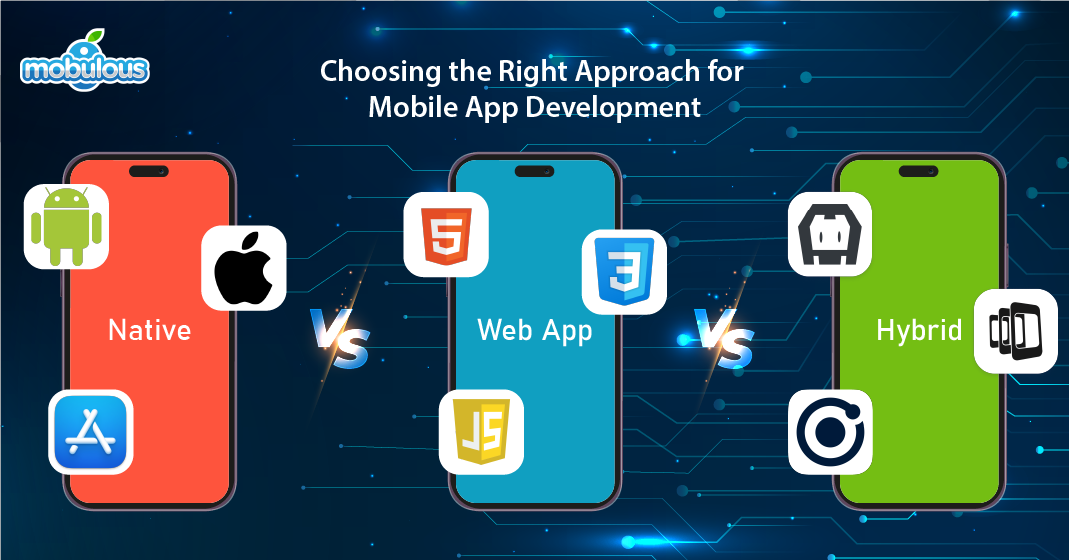
Performance, cost, and reach compared so you can decide whether a single codebase fits your product at all.
Continue Reading

Where a shared codebase helps budget, reach, and speed when both stores are on the roadmap.
Continue Reading
"The project management was excellent, and Mobulous delivered our food delivery app on schedule."
Verified on Clutch →"What really stood out with Mobulous was their ability to get the job done without delay."
Verified on Clutch →"Their reliability was the biggest asset when we set out to build a new app."
Verified on Clutch →Mobulous rates 4.7/5 on Clutch across 103 reviews. View the full Clutch profile →
Here hybrid app development means shipping a hybrid mobile application to iOS and Android from a single codebase (React Native, Flutter, or a classical hybrid stack). Buyers searching for a hybrid mobile development company usually mean that shared-build decision, not a debate between frameworks. Framework comparison lives on our cross-platform app development page.
When you need both stores in one release window, your features are mostly standard product flows (catalogue, booking, content, commerce), and one team must own both platforms. Use the scenario table above to score budget, timeline, complexity, and maintenance horizon.
When AR, advanced Bluetooth/IoT, heavy background processing, games, or OS-exclusive surfaces are core to day-one value, or when you can fund and staff separate iOS and Android teams. See native app development.
Same underlying tools in most modern projects. Different reader question. This page asks whether a single codebase fits your budget, timeline, and feature shape. The cross-platform page asks which stack to use once that answer is yes.
Cost depends on scope: screens, integrations, offline needs, and how many native modules you need. We do not publish a fixed range here because project shape dominates. Use the 90-second estimator for a ballpark, then a scoping call for a written estimate.
Timeline tracks feature complexity and store readiness, not a fixed average. An MVP with a focused feature set is faster than a multi-role enterprise product with deep integrations. The Hybrid Fit Assessment produces a schedule tied to your backlog, not a generic calendar claim.
Yes. We migrate Cordova, Ionic, Xamarin, and dual-native products onto maintainable React Native or Flutter architectures, with a cutover plan that keeps store presence during the move.
For most business and consumer products (booking, commerce, content, dashboards), a well-built React Native or Flutter app meets user expectations. Gaps show up in sustained graphics, heavy animation, and low-level hardware work. If your product lives there, we recommend native.
Mobulous is a mobile app development company and a hybrid mobile app development company that helps founders and product teams decide whether a shared iOS/Android build matches budget, timeline, and feature shape. As a hybrid application development company we have delivered 700+ apps over 12+ years, rate 4.7/5 on Clutch (103 reviews), and operate from Noida, Newark (Delaware), and Calgary (Alberta).
Proof on this page includes React Native products (BNC AIR, FoodKarma) and a Flutter client (LystGenie). If you already know hybrid is right and need Flutter vs React Native vs PWA, use our cross-platform app development guide. If platform depth wins, start with native app development.
Need a cost ballpark first? The 90-second estimator gives a range before the call.